Thank you for being a Pro-Demnity client. We greatly appreciate working with your firm.
At Pro-Demnity, we believe the keys to helping you succeed are to understand your experiences with us and your perspective on how we are doing. To get an objective understanding of these important matters, we have engaged an external firm, Acceleration Strategy Inc. to survey our clients.
During the week of October 24th, policyholders will receive an email invitation via Qualtrics and Acceleration Strategy with the subject line: Share your experience – 2022 Pro-Demnity Client Survey. It will include a survey link asking you to complete a short online survey. Although the link is unique to you and not to be forwarded, all data collected is anonymous (unless you provide contact information) and will be aggregated. You will be able share your feedback on a range of topics, including ease of doing business with us as well as satisfaction with products and services.
Every bit of feedback is valuable to us as it will allow Pro-Demnity to continuously improve to better serve your firm as your trusted, indispensable, and professional ally. The last time we conducted this client survey in the summer of 2019, we used your feedback to make enhancements in several key areas that were important to you, such as frequency and quality of communications, increased options for payment plans, improved access to online resources and risk information, as well as more claims stories.
As a thank you for completing the survey, Pro-Demnity will make a donation to charitable organizations such as: Water First, Assaulted Women’s Helpline, or Habitat for Humanity. Policyholders will be able to select from one of these three charities at the end of the survey.
Your ongoing feedback is invaluable as we work towards being an indispensable and trusted ally for you and your architecture practice, while continuously improving our value, service and offerings to all clients.
Thank you to all our policyholders for your support, assistance and interest in sharing your experience with us.
Pro-Demnity has moved offices as of November 1, 2022
Pro-Demnity Insurance Company has moved its offices effective November 1st, 2022.
Our new business, street and mailing address is:
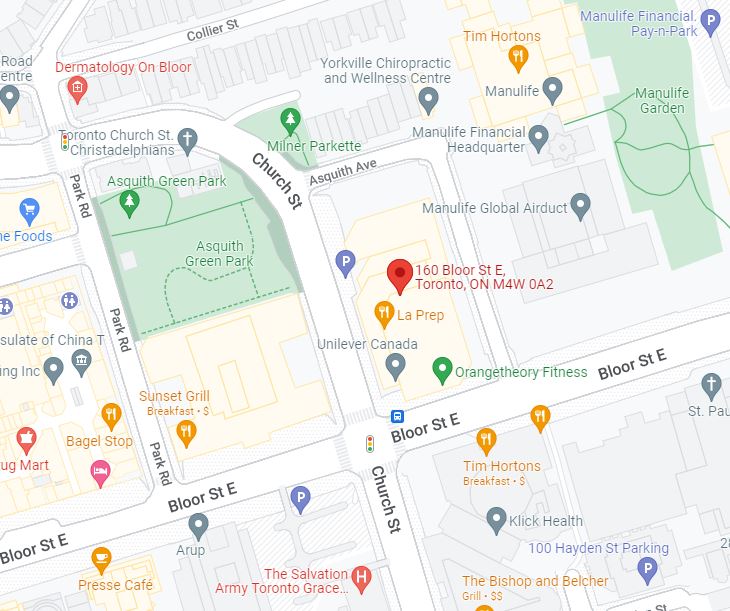
160 Bloor Street East Suite 1001 Toronto, ONM4W 1B9
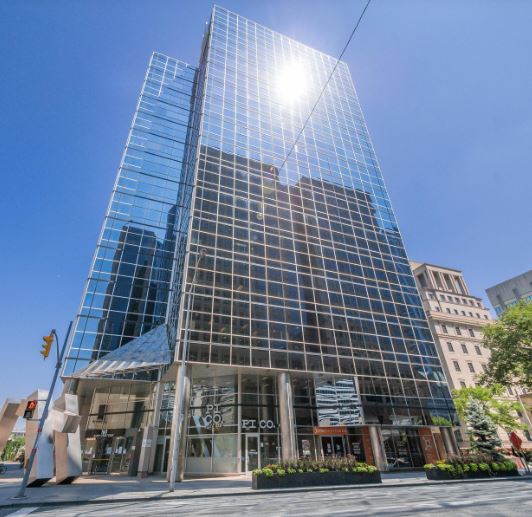
The office building, also known as the “Unilever” building, is LEED EB Gold certified, and situated on the Northeast corner of Bloor St. E. and Church St.
What you need to do
• Update your address books/contact lists/records on all devices. Delete the old address and use the new Bloor Street address starting November 1, 2022.
• Direct correspondence via couriers (I.e., Fed Ex, UPS etc.) to the new Bloor Street address on and after November 1, 2022.
• Correspondence sent via Canada Post, that is already in the mail prior to November 1, 2022, will automatically be forwarded to Pro-Demnity at the new Bloor Street address.
• Please use the new Bloor Street address on all future correspondence to avoid any postal delays.
• Our offices at 200 Yorkland were vacated as of October 21, and staff will continue to work remotely until our offices at 160 Bloor Street East are fully functional.
• Any courier delivery or in-person mail delivery after October 21, at either office should be left with Security on the Ground Floor.
Only our address is changing. E-mails, phone #’s stay the same.
• All of our E-mail addresses and telephone numbers stay the same, so you may reach any department or member of the team by their current business email and phone number.
• Visitors are by appointment only, as we are working hybrid. Video calls are preferred, and you are encouraged to request one with a member of our team.
Thank you for your support over the next few weeks as we transition our head office to this new location.
The location provides Pro-Demnity with a smaller, more modest physical footprint aligned with our hybrid work, while being TTC-accessible when we need to work in-office. The move, a result of our lease expiring in North York, supports our corporate sustainability and responsibility efforts to conduct business effectively within an existing built environment, while serving the professional liability insurance needs of our architectural clients across Ontario.
This message was first posted on September 1, 2022, and has been updated since being published.
Pro-Demnity protects + defends architects effectively. Here are three things we can’t do for you.
We regularly hear requests for us to tell architects’ clients they “are wrong” (or their contracts are bad, or the fees are too low, or the requested limits are too high). “Why can’t Pro-Demnity do something?” we are asked.
We are always humbled that our community of practice believes we have dominion over issues affecting the profession, or situations that are seemingly out of their own firm’s ability to control. We are, however, an authority on risk, and in this area, we can and do share our expertise.
As the architects’ professional insurer and trusted ally, Pro-Demnity helps guide architects as to how they can act on these issues and manage or mitigate the risks, but, ultimately, we are not able to force or forbid anyone or any entity to do anything.
As an insurance company [regulated by the Financial Services Regulatory Authority (Ontario)], Pro-Demnity:
1. Cannot tell architects or their clients what a contract must say. We are not a law firm and cannot provide legal advice.
Pro-Demnity can and does advise architects on the potential negative risk consequences of proposed contract wording and what parts may be uninsured or not covered by our policy, meaning it will be up to your own resources to defend and indemnify.
For government and publicly funded entities, this is a matter of good public policy and safeguarding the public (poor risk management increases and sometimes even creates risk).
For commercial entities, this is a matter of minimizing total costs (again, poor risk management ultimately increases costs), reputation management, and completion of future deals and projects.
Pro-Demnity can and does direct architects to retain qualified lawyers who are already familiar with architectural practice and the many issues that can arise in practice. Architects are encouraged to reach out to these professionals as a resource for their practice.
2. Cannot tell architectural practices what their fee must be.
Pro-Demnity can and does advocate for robust architects’ fees generally. It is our strong belief that the public well-being is threatened when architects take on work for too low a fee, as practices are then unable to assign the necessary resources to do the job properly, potentially endangering public safety.
We do believe that fees should reflect the architect’s unique value proposition and capabilities, as well as account for project risks.
But we also accept that only the architect ultimately determines how much they are willing to work for: only you can say yes or no.
3. Cannot tell architects (or their clients) what limits of professional liability insurance coverage are enough.
Pro-Demnity can and does share information regarding the mandatory minimum limits of coverage, and we do share concerns when high limits are requested by clients. Sometimes these requests may be a sign the client is planning to use the insurance policy as a contingency relief fund rather than for legitimate alleviation when unanticipated mistakes, errors or events arise. This costs every architectural practice in the form of higher insurance premiums. But we also understand that there is always risk.
We are aware that claims against architects may arise from both inside the contract and outside the contract, meaning that contractual indemnity limitations and caps are not the complete definition of how much insurance may be enough.
We know that many Third-Party claims (such as personal injury claims) are unrelated to project size or fee received. On large, complex projects we have also experienced that even a relatively minor apportionment of liability on a claim of tens of millions of dollars can represent a significant dollar amount.
As your professional liability insurer, Pro-Demnity cannot make decisions for you or tell you how to run your practice.
Ultimately, Pro-Demnity can and does provide valuable risk education, guidance and assistance – through our Risk Services team – to architects and practices about the factors to consider in deciding upon the risks you and your firm take.
Pro-Demnity insures the Architect’s Professionalism – not Products, Processes or Materials
We frequently get questions about whether Pro-Demnity insures a certain method of design, or a certain material, or a process, etc. We have even been asked if we insure walls.
The short answer is we do not insure any of those items.
We insure YOU, the architect, against liability from allegations of professional error or omission in your work as an architect. When there is a professional liability allegation against an architect (and it often involves materials, design methods, processes, etc.), every claim is treated on its own merits, with a defence to the architect being offered in line with the Pro-Demnity policy.
In a similar vein, Pro-Demnity does not endorse or pre-approve any products, materials, or processes.
Whether a product meets the requirements and standards for your and your client’s purposes – and whether, for example, a product or system might meet the water ingress coverage requirements within Pro-Demnity’s policy – is a decision you, as a Professional Architect, are responsible for making.
We hear there are companies that advertise their product as meeting Pro-Demnity’s requirements. We cannot comment on whether it is true or not, but we can assure you that we have not endorsed the product. The proof of whether this is a true or false statement will depend upon how the product is used, the design you create, and if a claim of error, omission, or negligence against you arises as a result etc.
There is no product that is “pre-approved for use” by Pro-Demnity, so be mindful and wary of any such public claims and do your own due diligence.
It’s also helpful to understand the benefits, coverages, limitations, and exclusions of your professional liability insurance policy, as this may help you to be more aware of potential risks (both insured and uninsured).
Ultimately, it is up to every architect to decide how to apply their professional skill and experience in their project, including the specification of materials, processes, or products as relevant to your work.
Claims and Architect expertise expands at Pro-Demnity. Architects poised to benefit.
For many years, Pro-Demnity’s in-house architects have provided valued risk services to architectural practices across the province, while being involved in the claims management process. It is part of our “architects insuring architects” approach. In the last few years, Pro-Demnity has experienced an increased need amongst architects for risk services, that is, risk insight, solutions, general advice on risks and professional liability insurance implications. For architects proactively seeking to avoid claims and better manage risk, speaking to an experienced architect who is well-versed in both insurance and risk, has been progressively more sought after. We are now addressing this need by allocating architect resources accordingly.
Here are two things Pro-Demnity is doing to better support architects with claims handling as well as risk services and education:
New Claims Specialists:
Three new Insurance Professionals have been added to the Legal and Claims team. We welcomed Jay Pahk, Jack Daiter and Darshana Radhoa in March 2022.
Each of them has significant depth of expertise in the management of professional liability insurance claims and serve as Claims Specialists.
They are taking over day-to-day administrative management of existing claim files, with direct support from our architects Sal Knafo and Leslie Parker.
Both Sal and Leslie are working closely together with the Specialists to ensure an effective transfer of knowledge on the files by the end of July and will strategize and coordinate with our Claims Specialists where required.
Sal and Leslie will continue to be consulted as required on all existing and new claims, as necessary.
A New Department is being Established
The expanded talent in claims, now enables Pro-Demnity to further enhance our Risk Services and Risk Education capabilities to architects.
Sal will join John Hackett, our VP Practice Risk Management and Leslie Parker, our newest architect on staff, to form a new department. Leslie joined Pro-Demnity at the end of May 2022, adding knowledge and capacity to the architect team to support clients, and the claims process.
Reporting to the CEO, the intent of this department is to increase our ability to provide architects with personalized, one-on-one risk guidance.
Together, they will continue to be a valued sounding board to architects and firms facing pressing, risk-related issues.
This new department will be better positioned to respond to architects’ requests for help and assist them to proactively manage risks associated with their practice in wise, effective, and efficient ways.
Our in-house team of architects will continue to be consulted as required on all existing and new claims. We have mapped out our claims process and identified the key points at which architects will be consulted, and our Claims Specialists and Architects will work together to ensure proper claims support is maintained.
We look forward to sharing more details about this department, and more specifically how they will serve architects, later in the summer.
Pro-Demnity’s commitment to protect and defend architects is further enhanced by these updates to our operational practices, while maintaining the services and supports that clients rely on.
Updated April 24, 2023
Claims Expertise Deepens to Serve Architects Better
Did you know that Pro-Demnity’s Legal and Claims department processes and manages every claim and allegation of error, omission or negligence levied against Ontario architects? The team is at the forefront of defending architects in the 6000+ claims reported over 35 years.
As part of our ongoing key priority to Strengthen Operations as shared in our 2022 Annual Update, we’re increasing support to architects when claims arise, by adding three new Insurance Professionals to the team. We welcomed Jay Pahk, Jack Daiter and Darshana Radhoa in March 2022. Each of them has significant experience in the management of professional liability insurance claims and serve as Claims Specialists.
Their addition gives Pro-Demnity an exceptional breadth of expertise with which to continue to defend Ontario architects. Our claims team is further strengthened by a formidable legal team which includes Philip Ghosh, Christine Lau, and Amy Spagnolo, all led by Rosemarie Hurst, VP Legal and Claims.
Over the next few months, existing claim files will transition to our new Claims Specialists with the goal of having the transition complete by July 2022. The Claims Managers and Specialists are working closely together to ensure an effective transfer of knowledge on active files and continue to strategize and coordinate where required. This collaborative trifecta of Claims Managers, Specialists and Lawyers leverage their unique expertise and dedication to clients’ cases, while striving every day to be the architects’ professional, trusted ally.
Later this summer, we’ll share additional updates and keep you apprised of our plans to further increase support to architects and architectural firms.
Pro-Demnity Sponsors the 2022 Canadian Conference of Building Science and Technology
Pro-Demnity Insurance Company has signed on as a Silver Sponsor of the 16th Canadian Conference of Building Science and Technology, presented by the Ontario Building Envelope Council (OBEC). The Conference is set to take place October 27 and 28, 2022 at the Paramount Event Space in Vaughan.
“We are delighted to be a Silver Sponsor of this year’s conference,” shares Bruce Palmer, President and CEO of Pro-Demnity. “This is a purposeful investment in supporting the work of building envelope specialists, who render valued services to architects and architectural firms.”
When offering risk mitigation guidance to practices, Pro-Demnity’s on-staff architects and risk experts often suggest there is value to their firm in seeking the services of a qualified building envelope specialist as one of several key sub-consultants.
As the architects’ professional liability insurer, Pro-Demnity focuses on supporting the architectural profession to enable the improvement of society and human interaction through better design by encouraging the wise, effective, and efficient management of risk.
In this way, Pro-Demnity shares the Ontario Building Envelope Council’s interest in “bridging the gaps amongst the architectural, engineers, research, manufacturers and construction communities” as well as working collaboratively with our communities of practice to “address the challenges facing performance and sustainability.”
“The Ontario Building Envelope Council is pleased to partner with Pro-Demnity and are happy to have them on board as a silver sponsor for the Canadian Conference for Building Science and Technology in 2022,” says Mila Aleksic, OBEC President. “Since 1987, OBEC has been supporting architectural, engineering, research, manufacturers, and construction communities. Our non-profit organization addresses today’s challenges facing building performance and sustainability. One of OBEC’s keys to success is our dedication to building science education at all levels. We are excited to work with Pro-Demnity to promote our shared goals of creating better-performing buildings and managing design risk through following sound building science principles.”
Pro-Demnity encourages architecture practices and principals to support the architects, project leaders, and associates in their firms, to augment their knowledge of building envelope sciences and technology as a risk mitigation strategy for the firm, by attending the Conference, or becoming more familiar with the value that Building Envelope Specialists can add to design practices and quality assurance.
Almost every liability (professional or otherwise) insurance policy has a territorial or jurisdictional limit, often referred to in terms such as “Your Policy Territory”. Some policy territories can be relatively narrow (“actions arising in the Province of Ontario”, for example), others broader or even global, with wording such as “The Insurer’s obligations under this Policy apply to Claims arising out of actual or alleged acts which occur anywhere in the world.”
You might be tempted to think that “anywhere in the world” means you have coverage anywhere in the world.
You are probably wrong.
There are at least two reasons you are probably wrong.
First, many liability policies cover you for acts that occur anywhere in the world but only if the resulting lawsuit is brought within the defined jurisdiction. This might look something like, “The Insurer’s obligations under this Policy apply to Claims arising out of actual or alleged acts which occur anywhere in the world provided that in the case of an act occurring outside of Ontario, Claims are made and proceedings are instituted in the Province of Ontario.”
Second, even if there is not a jurisdictional limit built into the policy, there are legal limits. Canada maintains a list of sanctioned countries, companies, and individuals that Canadian companies cannot do business with. This means your insurance company cannot transact with them either, including engaging local lawyers or making claims payments. In addition, most financial institutions operate internationally and, therefore, follow EU and/or USA sanctions as well. So even countries that Canada is OK with doing business with might very well be blocked because funds cannot flow to the country, company or individual.
For example, as of April 1, 2022, Pro-Demnity Insurance Company is barred from conducting business in Iran, Syria, Cuba, North Korea, North Sudan, Crimea, Venezuela, Russia, Ukraine, and Belarus.
These lists change over time – they are largely driven by political forces rather than economic ones – and you also need to pay attention to them from your own business perspective of where you choose to do business.
What To Do
There are several actions you can and should take in managing the risks associated with foreign projects. Specifically related to sanctions, some actions to take include:
Consult your lawyer to ensure you are not violating current law by engaging in a foreign project.
Ask your lawyer about what happens if the rules change part way through a project and the jurisdiction (or individual or company you are working with) gets added to a sanctions list. Does your lawyer recommend a Termination clause allowing you to cancel your obligation with no penalty should that event happen? How will you get paid in such a circumstance, and in what currency?
Talk to your current insurer about what they can do to help. For your professional liability with Pro-Demnity, for example, we can sometimes add foreign jurisdiction coverage. Although these endorsements cannot address sanctioned countries, individuals or companies, they may be able to address some other local issues.
Consider arranging local insurance in the jurisdiction you are operating in. This can be challenging as insurance rules and practices (and availability of products) varies significantly around the world. Just because a product might have the same or a similar sounding name does not mean it is the same thing. Insurance law also varies significantly, so ensure you understand your rights and entitlements under local law. Use an agent or broker who does business in the jurisdiction you are going into, so that they know the local practices, terminology, and language.
Foreign projects always involve some level of heightened risk, and we always recommend you engage legal counsel familiar with (and licenced in) the jurisdiction where you are working. This includes “friendly” jurisdictions like the USA, UK, etc.: a legal issue in London UK is very different than a legal issue in London ON.
Foreign projects can be a great opportunity … for either great success or great failure. Sometimes, winning a foreign project is a steppingstone to expanded opportunities; sometimes it is an indication that the local firms know something you do not know. Do your homework, know your strengths and capabilities, and be prepared. An important part of that preparation should be a careful look at the impact of sanctions and other international restrictions.
2022 Annual Update
Of prime importance to Ontario’s architectural practices is access to top quality, competitive professional liability insurance for all – regardless of insurance market gyrations, natural catastrophes, or even global pandemics. To this end, Pro-Demnity continues to be focused on ensuring Ontario architects are protected and defended against accusations of error or omission.
Taking a protective stance and maintaining a sustainable insurance operating model, Pro-Demnity’s financial performance was in keeping with expectations for 2021, and the organization performed admirably while implementing operational priorities during a most challenging time.
Financially, our fiscal performance was solid, maintaining our capital stability with a year-end Minimum Capital Test Ratio of 238%, and a Combined Ratio of 102%. The rate increase for the 2022 renewal year will continue to remain steady at 5%*, with administrative fees staying at 3%.
Our team has done an exceptional job this past year endeavouring to fulfil our promise to architects. From careful planning and strategic forethought at the leadership team level, to the commitment and diligence of all staff to strengthen and enhance operations and services, everyone has contributed to helping our clients at an uncertain time when they needed us most.
The strategic investments that will continue to be made in digital platforms and technology have been invaluable to our working effectively and serving clients while conducting business remotely.
We are grateful for the stewardship of our Board of Directors, the confidence of our shareholder, and most especially the trust our clients place in us every day to provide an alliance for protection. A few of your testimonials grace the pages of this year’s update, which I encourage you to read at your leisure.
On behalf of the entire team, thank you for working with us last year and allowing us to protect and defend your architecture practice.
Bruce H. Palmer
President and CEO
*Premium = rate x 3-year revenue average. For example, if 3-year average revenue increases by 5% and the rate increases by 5%, the premium increase will be 10.25%, all else being equal.
Architects’ Claims Stories: Real and Unreal
Every insurance claim tells a story of human behaviour. There’s the factual side: what happened and why? And there’s the outcome: the physical, economic, emotional, social, relationship or professional consequences.
Pro-Demnity has played a central role in Ontario architects’ claims for 35 years, helping architects when they’ve experienced allegations of error or negligence. The situations were so interesting in fact, that David Croft (retired VP of Claims) – a keen observer of human behaviour – noted many of them over a period of 20+ years, spinning them into a treasure-trove collection of 72 accounts of architects in trouble: what got them there, how Pro-Demnity helped them deal with it, how they recovered from it, and what this tells us about human nature.
Now, Pro-Demnity is adapting many of the 72 claims stories into a podcast series, to share them more broadly with diverse audiences through a popular, growing media format.
“The Claims Stories, and the podcast series based on them, provide architects and interns with insight into many of the situations which can lead to claims,” explains Iliana Arapis, VP Marketing. “These are very human stories that offer up learning moments about professional practice, in a light, and accessible way.”
The podcast also touches on how professional liability insurance helps to support a strong, viable defense for architects whenever there are allegations of design error, omission or negligence.
The 22-minute pilot episode No Written Recordcontains three claim stories, dealing with the consequences of an architect failing to keep written records. The Stories have been fictionalized, to protect the identity of the parties involved, but each recount the circumstances of a real claim, inspired by the 6,000+ that Pro-Demnity has defended over the years. The “cast of characters” involve the Architect, the Client/Owner, the Sub-Contractors and others – whose situations are part of an unfolding drama, from the origin of the claim right up to the often-surprising outcome.
As with all good stories, Pro-Demnity’s Audio Claims Stories impart practical lessons. Architectural practice may be deeply rewarding, but there are very factual risks – insured and uninsured. The Stories alert the listener to some of the pitfalls (mostly avoidable), while reminding us that architects are only human after all.
The inaugural, pilot episode is available to download now on Apple Podcasts, Google Podcasts and Spotify.
The Backstory
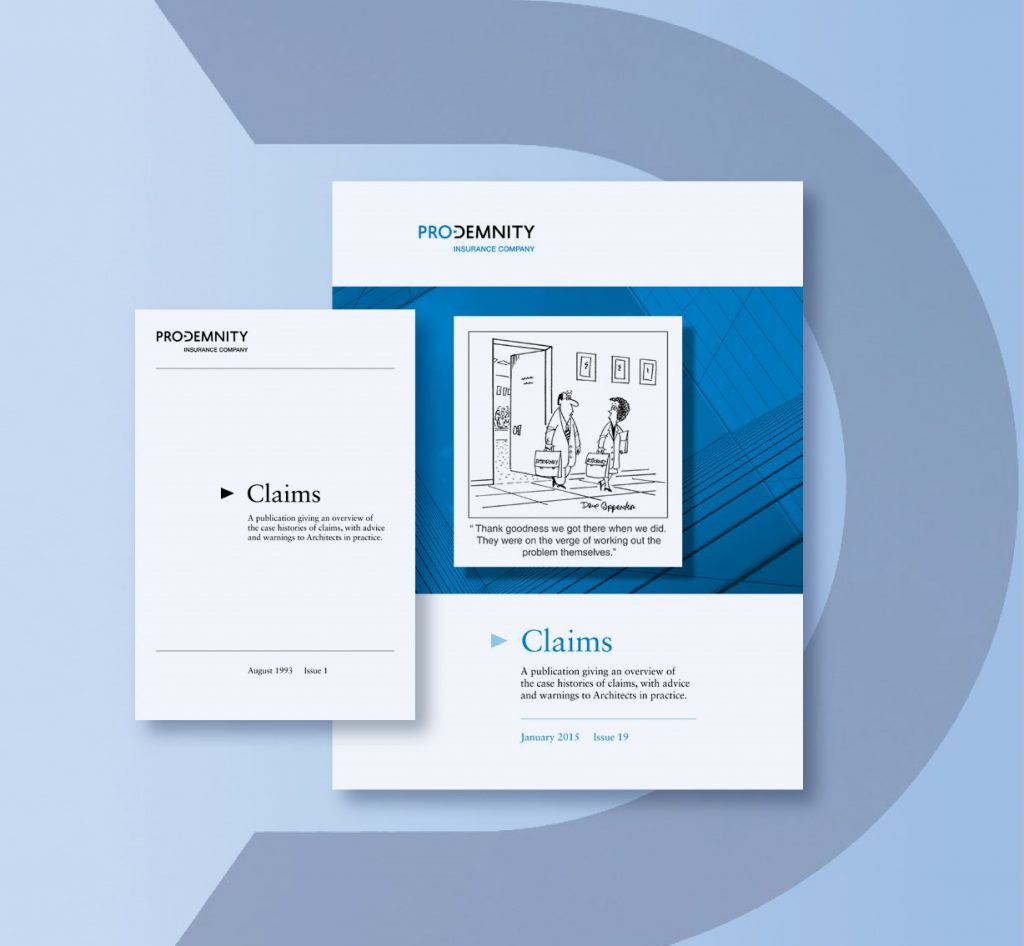
The story of Claims Stories began nearly 30 years ago, in August 1993. Like every architect, David Croft has always been a keen observer of human behaviour. As a reflection of this interest, and as a down-time “hobby,” he began recording his extraordinary experiences as Pro-Demnity’s claims manager in August 1993.
The stories grew in number until there were six dozen of them – 72 factual accounts (20 booklets) of architects in trouble: what got them there, how Pro-Demnity helped them deal with it, how they recovered from it, and what this tells us about human nature. The objective of the stories – then and now – is to keep architects out of trouble by demonstrating how easy (and usually avoidable) getting into trouble can be. Every Claims Stories issue began with the admonition: “There but for the grace of God go I.”
The idea for audio Claims Stories came to us as a suggestion from the OAA Interns Committee: Wouldn’t it be great if Pro-Demnity’s Claims Stories were distributed in audio form as well as in print and online? The wisdom of this suggestion is easy to confirm considering the perpetual overbooking of our Claims Events, and the popularity of our one-on-one risk management call-in service.
In our 2019 Client Relationship Survey, many respondents reported a deep affection for the Claims Stories booklets, and went on to suggest that we provide more communications vehicles of different kinds, in different forms. One respondent confessed that he or she had difficulty finding the time to read Pro-Demnity bulletins. We hear you. After staring at a screen all day who has the energy to read strings of words, no matter how important and interesting they may be? Also, you can’t watch a screen when you’re jogging or driving. At this point, an audio version of Claims Stories had become more than just a good idea. It had become a project.