Sorry. Not Sorry.

When something goes wrong on a project, your first instinct may be to apologize to your client, whether the fault is yours, or not.

Offering an apology to your client when something goes wrong on a project is a normal, healthy response. But, at the same time, you may be wondering if your polite behaviour might put you in a bad position somewhere down the road, in the event of an insurance claim and/or legal dispute. An attendee at our May 2021 Managing Risk virtual presentation may have had this in mind when they asked us to comment on an obscure piece of legislation called the Apology Act, 2009 (the “Act”). We are grateful to the attendee for raising this issue, because it’s something that every architect should know about. The Act itself is brief and its effect on possible liability seems simple and straightforward [see sidebar], but there is much devilry in the details, and exceptions to the law are many and varied.

So, however close your relationship with your client may be, and however benign your intent, heed this urgent piece of advice: Before you apologize to your client for anything, think about it and consult your lawyer and/or insurer.

The Act is premised on the idea that an apology can be a powerful tool. In professional practice, a timely apology may not be just an act of courtesy1; it may also go some way toward maintaining or repairing relationships2 and protecting your reputation. In the event that a legal dispute arises, an apology can often facilitate settlement and decrease litigation times.3
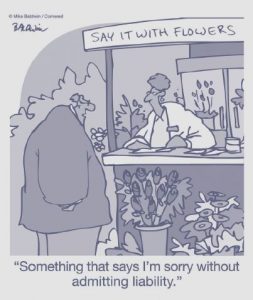
OFFERING AN APOLOGY TO YOUR CLIENT WHEN SOMETHING GOES WRONG IS A NORMAL, HEALTHY RESPONSE. BUT, AT THE SAME TIME, YOU MAY BE WONDERING IF YOUR POLITE BEHAVIOUR MIGHT PUT YOU IN A BAD POSITION SOMEWHERE DOWN THE ROAD.

If the Apology Act, 2009 did not exist, wise architects might be correct in assuming that any apology could be used as evidence of an admission of liability, and would be reluctant to apologize under any circumstances.

Although the Act helps to alleviate these concerns, it contains a number of significant exemptions to its application, and should not be regarded as a cure-all…under any circumstances. The Act does not apply in
criminal proceedings, or provincial offence proceedings,4 which cover a broad range of offenses. These include, quoting the Act, “charges for violation of the Occupational Health & Safety Act, Environmental Protection Act, Building Code Act, municipal by-laws, or other similar matters.”

The Act also does not apply if an apology is made while testifying at a civil proceeding in court or during an out of court examination5 – although there are exemptions to this exemption.6 Lastly, the Act does not apply for the purposes of section 13 of the Limitations Act, 2002,7 regarding a “claim for a payment of a liquidated sum, the recovery of personal property, the enforcement of a charge on personal property or [relief therefrom]”.8

In such cases, an apology would start – or restart – the claim limitation period. In addition, while the Act protects against the use of an apology – or statements of regret or sorrow – as evidence of an admission of liability, if the apology or statement at issue includes an express admission of liability, then that express admission may well be used as evidence in a civil proceeding. The Act defines an apology as:

…an expression of sympathy or regret, a statement that a person is sorry or any other words or actions indicating contrition or commiseration, whether or not the words or actions admit fault or liability or imply an admission of fault or liability in connection with the matter to which the words or actions relate.

Unfortunately, the courts may have difficulty determining whether any statement is in fact an apology under this definition. After undertaking a “contextual analysis” to determine which parts of the apology are admissible,9 there may still be some confusion. Elements of the apology that constitute “statements of regret” or the like will not be admissible; however, any admissions of material facts (or facts from which liability can be inferred), or express admissions of liability may be admissible. For example, if you say you are sorry that a problem has occurred, that statement cannot be used against you in a civil proceeding. But if, at the same time, or in the same correspondence, you make a statement about the suspected cause of the problem, that statement will be allowed as evidence. As a result, both oral and written apologies must be very carefully considered in order to avoid falling outside of the protections of the Act.

That is not to say that architects ought to remain silent or ignore potential problems as they arise. Such an approach would not do much to advance or maintain client relations. So how can architects express regret without implicating themselves?

Architects can tell the client that they are sorry about the situation, and otherwise demonstrate sympathy or regret, but must be careful not to accept or admit responsibility for the problem. In fact, where appropriate, the apology should be worded with a reservation that expressly denies liability. It is also important to avoid making any statements or admissions regarding the existence, cause or scope of the problem, which the client may feel is greater than it truly is. Further, the architect should avoid making any promises to make amends or repair any harm, whether through payment or other means, since this may be construed as an admission of legal liability.

BILL 108 2009: An Act respecting apologies

Definition

In this Act,
1. “apology” means an expression of sympathy or regret, a statement that a person is sorry or any other words or actions indicating contrition or commiseration, whether or not the words or actions admit fault or liability or imply an admission of fault or liability in connection with the matter to which the words or actions relate.

2. Effect of apology on liability
(1) An apology made by or on behalf of a person in connection with any matter,
(a) does not, in law, constitute an express or implied admission of fault or liability by the person in connection with that matter;
(b) does not, despite any wording to the contrary in any contract of insurance or indemnity and despite any other Act or law, void, impair or otherwise affect any insurance or indemnity coverage for any person in connection with that matter; and
(c) shall not be taken in to account in any determination of fault or liability in connection with that matter.

The architect may advise the client that it has put its insurer on notice, but should make clear that this has
been done out of an abundance of caution only, and that the architect does not accept or admit responsibility. These rules apply equally where the client suggests, or the architect suspects, that a subconsultant retained by the architect may be responsible for the issue. The architect is ultimately responsible for the contract with the subconsultant, so by agreeing with the client or otherwise ascribing blame to the subconsultant, the architect will risk facing liability for whatever damages, delay or extra costs that have been caused by the subconsultant’s error.

The distinction between an apology and facts that can constitute an actual admission of liability is critical, not only when it comes to ensuring the architect maintains the protection of the Act, but also to ensure that the architect does not compromise their professional liability insurance coverage, which requires that the architect must not take any action that would prejudice the insurer’s ability to defend the architect. This exclusion applies even if the architect believes that it could be responsible, or partly responsible, for the problem.

When problems arise, a sincere and heartfelt apology can go a long way toward maintaining or repairing a client relationship. Sharing an expression of regret, is generally the right thing to do. But to avoid prejudicing your rights, it must be done in the right way.

Contributing Author: Danielle Muise

Danielle Muise was called to the Ontario Bar in 2016 and is an associate in the Litigation Group at Aird & Berlis LLP. Her practice focuses on civil litigation, with an emphasis on corporate and commercial matters. She has acted in commercial, competition, construction, municipal, professional liability and real property matters. She regularly appears before the Superior Court of Justice, Court of Appeal, Divisional Court and Small Claims Court. She earned both her J.D. and her B.A. in International Relations from the University of Toronto.

Danielle can be reached at Aird Berlis LLP:
Brookfield Place, Suite 1800
181 Bay Street, Toronto, ON Canada M5J 2T3
T: 416.865.3963 E: dmuise@airdberlis.com


NOTES

1. The Act comes across as uniquely Canadian legislation, but in addition to other Canadian jurisdictions (all except Quebec), many US and Australian states have enacted similar legislation.4
2. Ontario, Legislative Assembly, Official Report of Debates, 39-1, No 71 (7 October 2008) at 3146. Members of the Legislative Assembly focused on relationships where trust is essential, for example doctor-patient relationships.
3. Ibid.
4. Apology Act, 2009, SO 2009, c 3, s 3 [Act]. Provincial offences being acts or omissions considered an offense under provincially enacted legislation. For example, speeding under the Highway Traffic Act.
5. Ibid at s 2(4).
6. The latter exemption would not apply to apologies made in without prejudice settlement discussions during the course of a civil proceeding, which are subject to settlement privilege.
7. SO 2002, c 24, Sched B.
8. Act, supra note 5 at s 4.
9. See, for example, Coles v. Takata Corp., 2016 ONSC 4885 and Cormack v. Chalmers, 2015 ONSC 5599.


Eight Insurance Risk Trends to Watch

The everyday management of risks comes with being a professional architect or architectural technologist.

Managing, mitigating, avoiding, transferring or accepting risk, becomes a conscious, purposeful daily act – a muscle that is routinely exercised – whether you’re the firm’s Principal / Managing Principal, an architect owner or an employee architect.

To help you stay on top of those everyday risks, Pro-Demnity provides regularly published Bulletins, articles in the Straight Line e-newsletter, risk education and news found across this website, which you’re encouraged to explore.

And, to assist you in thinking about risks that might affect your firm in the near future, we’re sharing eight trends that you should be aware of today:

  1. Accelerated size of projects
  2. Increased demand for higher liability limits
  3. Use of collaborative technologies
  4. Demand for resiliency
  5. Increasing scope of practice
  6. Increased dollar size of claims
  7. Competition for projects
  8. Fees being driven down

The latest Let’s Talk video from President and CEO Bruce Palmer, expands on these eight trends, providing relevant insights to help you future-proof your practice.


5 things a Pro-Demnity lawyer doesn’t want to hear from an architect

John Little, Partner, Keel Cotrelle LLP

Over the years, I have had a great many initial meetings with architects and Pro-Demnity Claims Managers as we start to learn more about the Claim being made against the architect. During those years, I have developed a list of the things I realize I don’t want to hear. These are five of the most important:

1. “We just had a verbal agreement”

It is surprising how many times even sophisticated architectural firms carrying out substantial projects have not entered into written agreements for their services, or are relying on a brief exchange of correspondence for their contract. Frequently, they will say, ” Well I had worked with that client for years,” or “We were in a rush,” or “I didn’t notice that our proposal wasn’t signed back.”

A written and signed contract (preferably OAA Document 600-2013) saves a lot of trouble down the road. It avoids any arguments as to what the architect’s scope was to be, who was responsible for hiring other consultants and what the nature of the architect’s contract administration obligations were. It is so much easier once a dispute arises and the client says, “I thought the architect was going to ensure my building was put up properly,” to point to the provisions in the written agreement setting out clearly that the architect was not required to make continuous onsite reviews and was not to be responsible for errors or omissions of the contractor in failing to carry out the work in accordance with the contract documents.

Equally important, OAA Document 600-2013 limits any Claim to the insurance available to the architect at the time the Claim is made. That is important protection for the architect. Often at the end of the project, the dispute is about money. A clearly written agreement will set out how the architect’s fee is to be calculated. Resolving that dispute by reference to the agreement will frequently avoid massive counterclaims when a small Claim for fees outstanding is owing.

Remember, just sending the agreement signed by you to the client is not enough. Make sure the client signs the contract and returns it to you.

2. “I signed the agreement the owner sent me”

The only thing worse than having no written agreement is signing somebody else’s form of agreement without proper review.

The owner is your friend until there is a problem. The owner’s form of contract was not prepared to assist the architect
and it needs to be reviewed carefully, preferably with your lawyer.

A clause in an owner prepared agreement provided:
The architect agrees to indemnify and save harmless the client with respect to any damages suffered as a result of any failure to construct the building in accordance with the provisions of the plans and specifications and any applicable building codes.

This of course imposes onerous obligations on you, as the architect, which you cannot fulfill. You are not the contractor, you are not on site 24/7, and you cannot see everything in your periodic reviews. In addition, your liability policy with Pro-Demnity excludes damages for any undertaking to indemnify where such provision creates a liability in excess of that which might otherwise arise under law – as this wording certainly does.

A contract provision from a government institution provided:
In addition to the services set out above, the architect will supervise the execution and construction of the Work to the extent necessary and ensure that the construction is completed in accordance with the final designs, final architectural and engineering plans and specifications.

This is problematic in so many ways as it requires the architect to supervise construction, and in essence provide a guarantee of construction. Again you are not the contractor and there is no coverage for such a guarantee. These are examples of owner’s contracts.

The same problem can arise with respect to your subconsultants’ agreements. Frequently, they may contain unreasonable limits on liability or indemnities on the part of the architect in favour of the subconsultants, leaving the architect to fill a financial gap between its liability to the owner and its right to collect from the subconsultants. They must be avoided. Use of document OAA 900 is encouraged when retaining subconsultants. Remember, if your arrangement with your subconsultant prejudices Pro-Demnity’s ability to defend you, it could lead to a denial of insurance coverage.

3. “I told my client I had made a big mistake”

All architects want to help their clients and get the project completed. Mistakes do happen; however, that does not mean that the architect is negligent. That may or may not be true, but you are not the judge. If you feel you have made a significant error, the first thing to do is to advise Pro-Demnity. You do not need to have been sued, or to have received a threatening letter from your client. Rather, this obligation arises as soon as you might reasonably determine that circumstances exist which could subsequently give rise to a Claim against you. Failure to advise Pro-Demnity immediately could result in a denial of coverage.

There are many reasons for this. The first is that we all lose perspective and our judgment suffers when we think we have made a mistake. It is far better to have a dispassionate professional review the situation. You will know the old adage about the lawyer acting for themself having a fool for a client. This holds true for architects as well. In addition, while admitting to your client that you made an error may be good for your conscience, it may potentially void your insurance coverage, which specifically prohibits your admitting to an error.

4. “I lost/destroyed/never had records for the project”

Most disputes arise sometime after the completion of the project, even years later. In litigation, lawyers like to ask, “Do you remember what happened in the July 15, 2016 meeting?” or “Why do you say the plaintiff authorized that change?” That is where records (now mainly electronic) come into play.

As the project progresses, a mass of drawings and sketches will be prepared. The architect’s usual temptation may be to simply keep updating drawings and on occasion deleting the early drawings. The early drawings should be saved – particularly those that have been forwarded to the client for review. This is particularly important in fee disputes, for example, where there may be an issue as to whether the architect actually reviewed the drawings with the client, or whether they were even created.

The more work which is producible, the more likely it is the fee will be recovered. It is very important to confirm significant instructions in writing. A short email is fine. When a dispute arises, a written confirmation will be the best evidence that instructions were actually given. For example, “Dear Client, this will confirm your decision to use XYZ cladding notwithstanding its higher long term maintenance cost.” It is important to prepare complete site visit reports. Architectural firms’ site visit reports vary dramatically. Some contain no information other than “The project appears to be proceeding satisfactorily.”

The Pro-Demnity Claims Manager in one meeting queried an architect as to why his site visit report contained so little information. The response was, “I thought it was better not to list anything so I could deny knowledge of any problems.” That of course is not particularly helpful when you are faced with multi-million dollar litigation. Reasonably detailed site visit reports show that you were conducting a proper review even if the particular item, which is ultimately at issue, is not referred to. The test is not whether you actually saw and identified the problem. The test is: Did you act in the manner that a reasonably competent architect would?

5. “Yes, that is my signature on the certificate”

The owner needs financing. The owner’s lawyer sends you a certificate and says I need it signed today before the project shuts down. I’ll be paying your outstanding fees out of the draw. The form says: Construction and development of the Project up to and including the Inspection Date has been performed in a good workmanlike manner and in accordance with the plans and specifications and all applicable building codes. This Certificate is given in connection with the above referenced advance under your construction letter agreement with the lender, and you may rely upon it in making such advance. You sign the form and email it back.

Three years later the project is in shambles. The lender cannot collect from the owner and pursues you on the basis of the Certificate. On discovery, the lawyer for the lender asks you, “Is that your signature? Was what you certified true?”

In another scenario, the project is complete and the local municipality will not give your client an occupancy permit without a final sign-off letter from you. The owner says every day is costing money. The form that you are being asked to sign says that you have inspected the construction and that it complies with your drawings and the Ontario Building Code. It omits the words “based on periodic site reviews” and omits the phrase “the construction is in general conformance with your drawings and the Ontario Building Code.”

Once again you are in a ZOOM discovery with the document being shared with you on the screen by plaintiff ’s counsel, and the question is asked, “is that your signature?” Although they often consist of only one page, certificates of final inspection are very important. Consider them carefully and if the wording is unusual, review it with your lawyer or Pro-Demnity before signing.

These are my top five. I hope not to hear them from you if/when we meet.

Our Contributor

John Little is a partner with Keel Cottrelle LLP, where he specializes in Civil Litigation and Insurance Law. Called to the Ontario Bar in 1976, he is a member of the Canadian and Ontario Bar Associations and the Advocates Society. John has been acting for Pro-Demnity Insurance Company since 1991, defending and providing advice to architects, while dealing primarily with professional negligence and professional discipline matters. When not spending quality time with architects or his golden retriever, John enjoys fishing and travel. John can be reached at: jlittle@keelcottrelle.ca


25 Things Within An Architect’s Control

  1. Adequate Scope of Services – Insist upon an adequate scope of services to meet your professional mandate and Duty of Care to the public
  2. Adequate Fees – Insist upon adequate fees for yourself and your subconsultants – sufficient to provide an adequate scope of services…so you can meet your Duty of Care to the public
  3. Manage your client’s expectations with respect to:
    – Process….stages, objectives, milestones
    – Time requirements…almost always longer than a client imagines or wants
    – Costs, budgets, need for contingencies
    – Codes…minimum adherence is the lawy, but you can do better, as long as the client agrees with doing better
    – Approvals by authorities…are out of your control
  4. Retain a lawyer – Do NOT act as your own “amateur lawyer”…retain a lawyer to assist you on contract and practice matters
  5. Learn to say “No…that doesn’t work for me!” to a potential client or anyone else who is entitled to rely on your professional opinion and advice
  6. Be prepared to walk away from potential clients, situations and circumstances that don’t meet or threaten your own ethical and professional standards
  7. Document everything you say and do in the provision of your services  – In writing!
  8. Meet your professional duty to advice / duty to warn your client about the implications of his / her demands and your recommendations….respectfully challenge your client
  9. Tell the truth – Be honest – always – even when your client doesn’t want to hear it
  10. Use Smart Contracts that:
    are compatible with your role as a professional
    do not expose you to additional liability beyond what is already yours “at law”
    do not expose you to uninsured liability
    – do not expose you to liability that exceeds your $ limits
    Smart Contracts are: contract wordings provided by the profession specifically for the provision of architectural services, and those of their subconsultants, or are written by your own lawyer
  11. Serve your own interests and needs – Use your agreements for your services to serve your own interests and needs as a professional
    – Use Smart Contracts for your own services, and
    – Use Smart Contracts for your subconsultants’ services
  12. Avoid contracts that expose you to uninsured obligations and liability – like Client-authored contracts
  13. Use available tools – To “fix” Client-authored indemnity Clauses
  14. Recognize and manage the inherent risks you face in a professional service business. Protect yourself and your practice.
  15. Develop and use a “Go / No go” tool for assessing potential new clients and projects
  16. Value your own experience – don’t repeat prior mistakes
  17. Read & understand the protections provided to you by your Professional Liability Insurance Policy (If you need an incentive, reading your Professional Liability Policy counts as self-directed Con-Ed points.)
  18. Coordinate the work of your subconsultants……actively, and through all phases of the work
  19. Recognize your limitations. Retain specialists where you lack experience or expertise:
    – Building Envelope…highest cost category for claims
    – Building Code…common source of claims
    – Costs…Client depends on you to respect their $$$
  20. Resist retaining “Owner’s Specialists” – don’t accept contractual liability for the work of others as a “convenience” to a client
  21. Pay attention to the Contract Administration provisions in a Construction Contract that you will be administering. Insist on:
    – Consultant  / Contract Administrator role consistent with your scope of services in your agreement with the client
    – Role consistent with Architects Act and Regulation
    – Dispute Resolution provisions that don’t prejudice you / your insurer’s ability to defend you effectively (Exclusion 7)
  22. Take control of your practice including the basis on which you are prepared to provide your professional services
  23. Avoid contracts that expose you to uninsured obligations and liability – like Client-authored contracts
  24. Monitor and update your QA process regularly
  25. Learn from the experiences of other architects

What Records Should I Keep

There is no simple rule. Which records prove to be most important will depend on the particulars of the claim and will differ in each instance. When litigation occurs, it is the lawyer’s task to find out what went wrong and who is responsible. But it is the Architect’s obligation to provide as much information as possible in support of one’s own defense.

A prudent Architect will maintain project records for at least 15 years after project completion. To minimize the risk of extending the limitation period, it is further recommended that Architects send their clients a letter identifying the date on which they last provided services and keep a copy in their file.

Architects who can produce their own records, rather than relying on those produced by the plaintiff, are generally better able to defend themselves in the event of a claim.

Adequate and well-organized project records may be taken by a court as evidence of sound administrative practice by the Architect.

A written record in an email or letter trumps recollections of conversations. But as the adage states: “A picture is worth a thousand words.” So, photographs or sketches that supplement site review reports may provide the most valuable aids to your defense.

15 most important records to keep

  1. Contract between Architect and Client
  2. Contracts between Architect and sub-consultants
  3. Construction contract between owner and General Contractor, Construction Manager or Builder (where available to the Architect)
  4. Insurance policies of sub-consultants
  5. Other insurance policies and bonds, where applicable (e.g. Builder’s Risk Policy, Performance Bond, etc.)
  6. Communication documents such as emails, letters, faxes, etc.
  7. Minutes of meetings
  8. Bid and tender documents
  9. Drawings and specifications
  10. Certificates of Substantial Performance, Letters of Assurance, Statements of Completion
  11. Field review reports, site review notes, site observations and photographs
  12. Supplemental instructions
  13. Change Order logs, RFI logs and shop drawing logs
  14. Certificates of Payment and Progress Payment support documentation
  15. Budget documentation

Do your Fees Adequately Reflect Project Scope and Risk?

You’re bidding on an exciting new project and asked to pull together the fee proposal (dread). Too high a fee and your proposal may be rejected. Too low a fee and the proposal might not reflect certain realities (and so, might be rejected anyway – even in a competitive environment). If only pricing out a project were as simple as applying a universally accepted formula.

Although an Einstein-worthy architectural equation for fees continues to elude the best of us, perhaps we can share some ideas on how to integrate more risk-thinking into your fees structure.

Science + Art + Risk = Fees

Pricing a project is part science, part art, and part risk assessment. These three factors are ever-present and in constant flux. They are also hard to price independent of one another, and often, risk is completely overlooked.

The science part is math unto itself.

These are the basic calculations that reflect the practicalities of running the project: the internal or external resources and consultants to support the project to a successful conclusion, the related labour or material costs, the profit margin as well as the share of the general business / administration overhead that the project represents. In the business world, these are often represented as “hard costs,” but there is fluctuation inherent in these as well, and in accordance with supply and demand.

The art part reflects your creativity and the firm’s expertise.

It’s the intrinsic value of your firm’s collective knowledge, design skill and professional acumen. For example, your ability to manage all the relationships and personalities that come with the project. Your problem-solving skills. Your learned experience of similar, previous projects.

Thinking honestly about what you and your firm bring to the table – the potential project benefits and outcomes (for you as well as your client) – is a valuable exercise to engage in at the start of each project. It provides an opportunity to assess new learning and experience that has been absorbed since the last project, providing a potential new starting point from which to inform the fees. Just as important, is the go/no-go decision: do your qualifications and interests mesh at all with the client and the project?

The risk part considers the potential risks to the project.

Every project is different so the degree of risk (known and unknown) will be different as well. The possibilities of delays, substitutions, scope change, labour or skills shortage, design flaws, use of client-authored contracts, project financing falling through, municipal or community stakeholder challenges, working with a new sub-consultant, etc., are just a few risks that are ever-present, but these and others will ebb and flow based on market, regulatory and business-environment conditions as well.

Embedding risk-thinking within the fees calculation helps gauge if there is sufficient professional liability insurance coverage in place in the event of a claim (or claims) related to that project. Would you need more coverage than your annual limits? Would your firm have sufficient funds to pay out of-pocket if it came to that? What would be the effect of taking on a higher deductible? Above all, it’s important to avoid accepting unfair or uninsurable risk being transferred onto you by your client, while at the same time, making sure that your sub-consultants assume their own fair share of the risk. It’s also an opportunity to re-read the professional liability policy to confirm coverage or limits for a particular risk and to speak with Pro-Demnity directly.

Professional liability insurance coverage is but one facet of a multi-pronged risk solution. Single-project insurance is sometimes a viable consideration for those one-off projects, as is increased limits, particularly if what used to be one-off projects have evolved into business as usual.

It can be empowering to think through risks when structuring fees because you can do something about those risks from the get-go, and price accordingly. You can, for example, actively remove known risks, mitigate existing risks, monitor the presence of risks and manage risks as they come up (and they will). When your scientific and artful pricing formula brings calculated risks into its equation, your fees may prove to be far more inclusive and representative of your value and offering.


Planning for Risk

On Risk

Life is risky. You don’t have to be an architect or a mountain climber to know that. U of T Professor Mark Kingwell puts it this way:

“If life were a game of chance, we would probably choose not to play: the chances are stacked in favour of the house and against the players.” – Mark Kingwell, On Risk

Right now, in a post-pandemic world, and with natural disasters increasing in frequency and severity, this seems especially relevant. But, in good times and bad, risks are everywhere. Managing them is a feature of life and a factor in all of our planning and decision-making, even when we don’t acknowledge it.

Listen to Your Mother

In everyday life, it makes sense to manage risk by taking certain precautions: If it looks like rain, take an umbrella. If your mother thinks it might get chilly down by the lake, don’t be difficult; take a jacket.

Taking risks in our personal lives may be unwise, inconsequential, or in some cases, exciting. Taking uncalculated risks in our work is bad practice, often uninsurable and even prohibited. As OAA members, we are required to plan for risk management – not for our own protection, but for the protection of the public we serve, in accordance with our provincial charter.1

Risk and Planning

The Dictionary of Insurance defines risk management as “Analyzing a risk to quantify the potential for losses in a specific investment and to decide what is the appropriate action to take (or whether not to take action).” The recognition of potential risks in any venture, and the decision to deal with those risks in deliberate ways form the basis of risk management planning.

What does risk management planning actually entail? In its simplest form, it means thinking about whatever project you’re about to undertake and determining how to avoid circumstances that might result in a bad outcome. The logical next step is to record these thoughts and share them with others involved in the project, especially those under your direction. So far, this only seems like good sense.

But given the complexity of many projects, and the tendency of many participants to adhere strictly to instructions, regardless of consequences, something more deliberate would be warranted – a Risk Management Plan. Such a plan should encompass any conceivable situation – insurable and, especially, uninsurable – and might serve as a working template for all future work.2

Risk and Reward

The idea of risk management planning sounds a little counterintuitive, even counterproductive, since, a) nobody knows what the future holds, and b) architects are meant to be innovators –creators of exciting new solutions to new and old problems. Does risk management imply that architects should avoid taking chances with new ideas?

Yes and no. If chances means uncalculated risks, then the answer is obviously yes. Never leap without looking. To corrupt an old phrase, “invention is the mother of liability.” But if taking informed chances means embracing new ideas by exploring the upside and the downside – i.e., managing the risk – the answer may be: go all in; try new ideas; take on new challenges.

But think things through; do your research; make a plan; then proceed with increased confidence.

Notes:

  1. “The principal object of the Association is to regulate the practice of architecture … in order that the public interest may be served and protected.” R.S.O. 1990, c. A.26, s. 2 (2). A download of The Architects Act, R.S.O., 1990, c. A.26, is available at https://www.ontario.ca/laws/statute/90a26):
  2. Confusing online advice abounds, but few helpful texts exist. Amazon offers: Managing Project Risk: Best Practices for Architects and Related Professionals. James B. Atkins, Grant A. Simpson. Hoboken, NJ: Wiley, 2008

Six Ways to Reduce Risk

In architectural practice, risk takes many forms. It’s comforting to know that your Pro-Demnity policy protects you against the risks of error or unintentional neglect.

The policy spells out the many things that are covered, as well those that aren’t. Bear in mind that a number of things aren’t specifically mentioned, simply because they aren’t responsibilities imposed by common law.1

This is to say that, “A professional liability insurance policy is not an all-risk contract. It is rather a safety net, providing protective cover within specified limits.”2

With this in mind, there are still many ways you can reduce your risks across the board. Here are six areas of particular concern highlighted in the recently published Canadian Law of Architecture and Engineering, Third Edition.3

Choosing the Project – Avoid those that may be problematic due to:

  • Feasibility – write down any unrealistic aspects in the feasibility study – or decline the work.
  • Client Resources – If the client’s budget is unrealistic, tell them – or decline the work.
  • Marginal Design Requirements – If a developer, e.g., cuts fees for design and supervision, but still wants all the certifications, be very cautious. Your liability may outlive your client.
  • Self-Appraisal – Be sure that the project lies within your capabilities and experience.

Defining Responsibility – Establish roles at the beginning and maintain communications. For example:

  • The client bears the responsibility to define its needs and objectives.
  • The architect provides the design and assists the client in getting a project that conforms.
  • The contractor is responsible for building the project.
  • The architect must be allowed to provide review sufficient to confirm conformity. Otherwise include a clause relieving you of liability for poor workmanship or material substitutions – or decline the work.
  • Make sure the client knows that additional consultants may be required; and that cost estimates are not guarantees.
  • The architect is responsible for ensuring that its budget is sufficient to cover its services, quality assurance, and contingencies for unknowns.

The Contract – Leave nothing to chance; get everything in writing; use standard contract forms; avoid client-generated contracts which may obligate you to assume liabilities beyond your insurance coverage; familiarize yourself (as well as your employees and consultants) with the contents; refer to Pro-Demnity Bulletins for useful notwithstanding clauses.

Design and Specifications – Understand the risks of innovative design and make doubly sure your client understands them. Embrace new ideas, but remember that innovation often inspires litigation. Observe the following quality assurance practices:

  • Always have another competent person check design calculations.
  • Check that detail drawings conform to overall drawings.
  • Consult specialists throughout the design process.
  • Check design regularly against geotechnical reports.
  • Be sure the specifications are clear and understandable.
  • Be certain that your design accommodates maintenance requirements.

Communications – Must be continuous, honest and complete.

  • Deal with tricky problems when they arise.
  • Don’t neglect interoffice, interdisciplinary and – especially – client communications.
  • Keep written records, as well as: (i) manufacturers’ warranties and specs; (ii) jobsite reviews; (iii) memos and change orders; (iv) notes of conversations and written confirmation of oral – especially rejected – advice; (v) deficiency lists and corrective steps; (vi) anything relating to substitutions; (vii) written advice to the client regarding covering of unexamined work; (viii) records of non-cooperation on the jobsite.

Certification – Undetected defects are normally covered by your policy, but may result in allegations of negligence. To avoid claims related to certification:

  • Certify only what you have seen. Otherwise, warn the owner in writing that “restricted field services were rendered.” You may still be on the hook, but your warning will help your defence.
  • When signing progress reports for a bonding company, include a disclaimer that the report should not be relied on as certification.

“[I]t is incumbent on all architects and engineers to familiarize themselves with the areas in which claims are most frequently made, and with prudent practices for avoiding [such] claims.”4

These six areas of concern may seem obvious to a seasoned architect, but anyone might make a hurried or ill-considered decision resulting in needless expense of time and money, as well as unnecessary aggravation. More generally the rising number and severity of claims inevitably leads to higher PLI insurance premiums. As Canadian Law of Architecture and Engineering, Third Edition sternly advises,

It goes without saying that adopting prudent practices is in your best interests, as well as those of your client.

Notes:

  1. The Canadian Law of Architecture and Engineering, Third Edition. McLachlin, Beverly M., Arthur M. Grant. Toronto: LexisNexis, 2020, 228
  2. Op. cit. 226
  3. Op. cit. 236 ff.
  4. Op. Cit. footnotes, 235

Client-authored Indemnification Clauses


Client-authored indemnification clauses inserted into a standard contract are a particular concern since, despite their benign appearance – just looking out for your client’s interests – they may be at your expense. To quote Pro-Demnity Claim Watch No. 24 (August 2005): 

Any agreement to indemnify or defend another party to a contract in excess of what you would be liable for in ordinary common law will not be insurable in the ordinary liability insurance context. 

This warning has been repeated in OAA Practice Tip PT.39.1, May 1 2019, (dealing with “Overly Broad Indemnification Clauses”), as well as Pro-Demnity Bulletins issued in 2005, 2015, and 2017, and Loss Prevention Events, including “Anatomy of a Murder (Clause).” Of note, Pro-Demnity Bulletin, March 22, 2018, “Client-Authored Contracts for Architectural Services,” tells us: of growing concern is contractual language promoted by some clients that has included a number of elements which exceed the architect’s existing liability at law and hence its insurance coverage; in effect transferring client’s or owner’s risk onto the architect. 

To nullify the ill effects of such client-authored indemnity wordings, Pro-Demnity has, for more than 16 years, offered a “Notwithstanding Clause” as an antidote: 

Notwithstanding the foregoing, the obligations and liabilities of the Architect are limited to the professional liability insurance provided by Pro-Demnity Insurance Company and any specific or excess professional liability insurance coverage in force. 

Current forms of Client/Architect Agreements for the provision of professional services developed and recommended by the OAA do not include an indemnity provision, reasoning that it is not required. An architect’s (or any professional’s) obligation to indemnify a client or others respecting damages arising from its professional services is already a matter of established law. 

However, there is a concern that the absence of an indemnity clause might be perceived as a “void,” triggering clients (or their lawyers) to concoct provisions to fill the perceived gap. Several years ago, with the assistance of two lawyers familiar with these issues, Pro-Demnity arrived at a “Benign Indemnification” that can be substituted for whatever indemnity wording a client proposes: 

The Architect shall, within the limits of its insurance coverages, indemnify the Client from claims, demands, losses, costs, damages, actions, suits or proceedings in respect of claims by a third party, or from losses, costs or damages suffered by the Client, provided these are attributable to error, omission or negligent act of the Architect or of those for whom it is responsible at law. 

Pro-Demnity has presented this alternate indemnity wording in recent Bulletins, at recent Loss Prevention Events, and in advice to individual architects. The wording has also been offered to the OAA for possible inclusion in the next update to OAA Document 600. This would have the benefit of filling any perceived void in the OAA recommended forms, perhaps heading off a client’s effort to fill the perceived gap. At the same time, the clause would provide suitable indemnification wording, in sync with the architect’s professional liability insurance and the OAA’s advice. An architect could compare this wording to whatever alternate a client might present.