Determining your Premium with the Experience Rating Factor

Pro-Demnity is dedicated to upholding fairness and integrity in our pricing and ensuring that premiums are priced equitably, in accordance with every architectural practice’s claim history. Understanding how your professional liability insurance premium is calculated can help you to manage your business and plan or forecast with confidence. 

In 2025 the Experience Rating Factor (ERF, or Experience Adjustment Factor), a loss ratio measure by policyholder against Pro-Demnity’s loss ratio, is being integrated into the existing premium calculation. 

Below is a simple illustration of how the ERF impacts premiums at the minimum mandatory level of coverage of $250,000 per claim.  

Step 1: Average out three years Gross Fees 

The average of the three most recent years of gross fees for an architectural practice are always used. This approach minimizes and smooths out large swings – either upwards or downwards – that a firm might experience, year over year. This favours all firms, whether they are experiencing downturns followed by growth bursts, and vice versa.  

Let’s assume that a fictional architectural firm, ZZZ Architects Inc., reported their fees as follows: 

Fees reported for 2023 renewal: $250,000 
Fees reported for 2024 renewal: $200,000 
Fees reported for 2025 renewal: $150,000 

Their 3-year average revenue (2023 – 2025) is: $200,000 

Step 2: Multiply the 3-year average of Gross Fees by the Annual Rating Factor (or rate increase) to calculate the Base Premium 
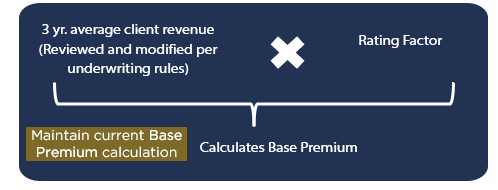
The 3-year average revenue is then multiplied by the Rating Factor (or Rate Increase) which is applied to every practice (regardless of individual claims history) annually upon renewal.  The rating factor provides additional capital cushion to the entire book of business in the event of severe and catastrophic claims.  Over the past seven years the rate increase has been between 1 % and 5 %. We encourage firms to consistently budget for 5 % increases in their financial planning scenarios and budgets annually. 

From April 1, 2025, to March 31, 2026, the rate increase is 4 %.  

This multiplication above, will yield the Base Premium as follows: 

$200,000 (3-yr avg revenue) x 4 % (rate increase) = $8,000 (base premium) 

This is the Base Premium for the practice upon renewal. Depending on the practice, there may be other applicable relative adjustments for deductibles, limits, etc., that will continue to apply.  

Step 3: Loss Ratios as inputs to the Experience Rating Factor  

The Experience Rating Factor (ERF) represents the firm’s loss ratio (severity of claims) over a period of 10 years as compared against Pro-Demnity’s equivalent loss ratio for the same period of time.   

For the 2025 ERF, the 10-year period is 2013-2022, reflecting claims losses incurred for that duration of time as of December 31, 2024. Any recent claims incurred in 2023 to 2024 are excluded from the 2025 premium calculation year because claims are unpredictable and fluctuate in their first two years. This exclusion is in the firm’s favour and provides them with sufficient time to plan for a stable potential surcharge in premiums in future years. 

The ERF for ZZZ Architects Inc. is unique to them and reflective of claim costs (paid expenses, or damages or both) based on severity and NOT the number of claims reported or actioned. We exclude all paid claims less than $5,000 in this calculation. 

So, we need to identify two loss ratios: that of Pro-Demnity’s and that of the firm’s for the same 10-year period. If the firm’s loss ratio is higher than Pro-Demnity’s, they will experience a surcharge on their premium. If lower, it will be a discount to their premium.
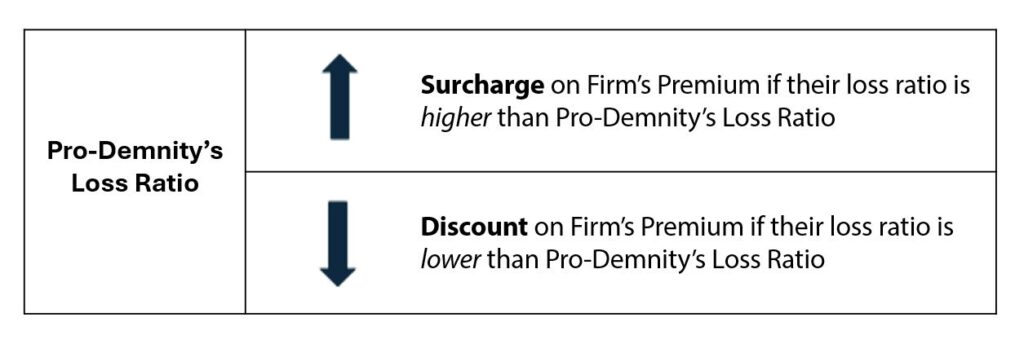
Let’s assume that Pro-Demnity’s loss ratio is 60 % and ZZZ Architects Inc.’s loss ratio is higher, at 75 % for the same 10-year time frame. After adjustments, the firm’s Experience Rating Factor is 1.0700. 

Step 4: Multiply the Base Premium with the Experience Rating Factor to calculate the Adjusted Base Premium 
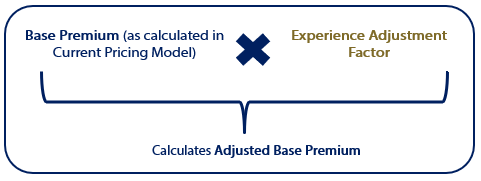
In the case of ZZZ Architects Inc., their Base Premium is then multiplied by the firm’s Experience Rating Factor (ERF) to determine their Adjusted Base Premium, which reflects a discount or a surcharge on their premium for the year. 

Base Premium x Experience Rating Factor = Adjusted Base Premium 

$8,000 (base premium) x 1.0700 (ERF) = $8,560 as the Adjusted Base Premium

ZZZ Architects Inc., would therefore have experienced a 7 % premium surcharge. 

Let’s now imagine a scenario where ZZZ Architects Inc.’s loss ratio was lower than that of  
Pro-Demnity’s in Step 3 above and that it was 53%.  After adjustments, the firm’s Experience Rating Factor is 0.97. 

Base Premium x Experience Rating Factor = Adjusted Base Premium 

$8,000 (base premium) x 0.97 (ERF) = $7,760 as the Adjusted Base Premium

ZZZ Architects Inc., would therefore have experienced a 3 % premium discount. 

The Impact of Increased Mandatory Limits on Premium 

As your architectural practice grows, so too will your mandatory limits of liability, and consequently, your premium. 

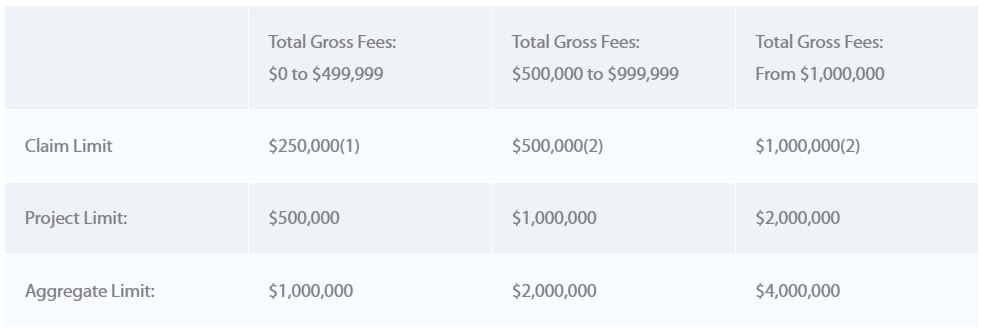
For example, when reported gross fees are over $500 K or $1 M, the mandatory Claim, Project and Aggregate Limits also increase commensurate with your firm’s growth (see the chart below). The jump to the next mandatory tier, triggers an increase in premium.  
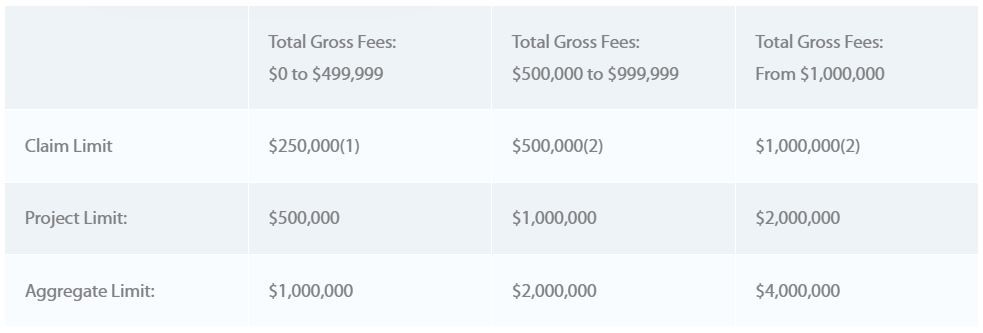
Table with four rows and columns that outlines the mandatory limits of liability

For increased limits premiums, the formula calculations begin the same way as steps 2, 3 and 4 above. However, there are additional inputs and factors specific to increased limits as well as further adjustment factors applied by reinsurers, to arrive at a Total Adjusted Premium.   

Should you require a more detailed explanation specific to your firm, please reach out to our Underwriting team after you’ve received your renewal package. 

FAQs for the Experience Rating Factor

Effective April 1, 2025, upon renewal, premiums will include an Experience Rating Factor (ERF) which will drive discounts or surcharges, based on a rolling 10-year period of claims. This helpful FAQ provides additional context for understanding the Experience Rating Factor and the impact to professional liability insurance premiums.

Pro-Demnity is introducing an Experience Rating Factor (ERF) into the existing Premium Calculation Formula for Annual Practice professional liability insurance. This update will factor in an architectural practice’s claims experience when calculating premiums. There are no other changes to the pricing model.   

The Experience Rating Factor (ERF) is a component of the premium calculation model that reflects an architectural practice’s history of claims severity. It adjusts the base premium based on the firm’s ten-year loss ratio compared to the overall Pro-Demnity ten-year loss ratio. 

The Experience Rating Factor will be applied in the Premium Calculation Formula starting April 1, 2025, upon policy renewal. 

Premiums will now reflect a 10-year history of claims (paid expenses, or damages, or both). Depending on your architectural firm’s claims history, you may receive discounts or surcharges on your premium for professional liability insurance. 

The update to the premium calculation model aims to continue to enhance fairness and reward positive risk-awareness habits within the architectural community. It responds to the majority of architectural firms that have been claims-free or have had a minimal number of claims over their lifetime. The spirit of this change is to align premiums more closely with actual risks incurred by architectural practices, while ensuring fairness across all architectural firms.

Pricing fairness matters to us and to all of our clients. When claims experience is factored into the standard premium calculation, then every practice pays their fair share of premium for professional liability insurance. By factoring in individual claims experience, the Premium Calculation Model ensures that discounts and surcharges are applied using the same formula, so that premiums are priced in accordance with each architectural practice’s claims history. 

All architectural firms will benefit as premiums will reflect their actual claims experience. With claims experience factored into the standard premium calculation, every practice pays their fair share of premium for professional liability insurance. It allows the majority of practices with a positive claims history to potentially receive discounts, and gives firms with significant claims, sufficient time to plan financially for future surcharges, or to adjust their planning annually to account for severe claims within a 10-year period. 

The ERF is based on the individual policyholder’s ten-year loss ratio compared to Pro-Demnity’s loss ratio for the same time period. Depending on this comparison, the Base Premium will be adjusted between a 3% discount and up to a 7% surcharge. 

The ERF considers the severity of claims, not the frequency. It reflects claim costs over a ten-year period (paid expenses, or paid damages, or both) and excludes all paid claims less than $15,000. 

Annually, the ten-year loss ratio period will exclude the two newest years’ loss ratios. For example, for the 2025 renewal year, the period used will be 2013-2022; in 2026, it will be 2014-2023, etc.  

The premium calculation model is based on the architectural firm’s most recent three-year average reported gross fees, with adjustments for deductibles, limits, the annual rate that is applied (up to 5%) and other factors. This model has been in place for 38 years and provides a stable and predictable premium structure.  

Staring April 1, 2025, the claim experience factor will be integrated into the formula which adjusts the base premium based on the firm’s ten-year loss ratio compared to the overall Pro-Demnity ten-year loss ratio. Specific details of the formula are provided in renewal documentation. There is no other change to the formula other than the inclusion of the ERF. 

Once gross fees exceed either $499,999 or $1M, new mandatory limits are applicable, resulting in a higher premium for these established coverage limits. Please refer to Architects Insuring Architects for more detail.

Architectural practices are reminded of their obligation as policyholders to notify Pro-Demnity of potential claims promptly so that we can act immediately to defend and protect your firm from any allegations of error, omission, or negligence. Policyholders will find this obligation outlined in their policy and are encouraged to visit the Report a Claim page on our website; e-mail us at claims@prodemnity.com; or call us at 416-386-1770 x1.

While claims cannot be entirely avoided, architectural practices can mitigate and manage risks. For starters, read:

  1. your Professional Liability Insurance Policy together with the Technical Requirements Schedule,
  2. risk management articles and bulletins published on our website
  3. Speak with an Expert for personalized guidance. 

Policyholders who are currently subject to the Claims Expense Contribution (CEC), will remain in this program for the foreseeable future. The CEC is a deductible that was introduced in late 2019, as a means of recovering claims costs from a small handful of firms whose loss ratios significantly exceeded their premiums due to frequent and severe claims. These firms are expected to pay their CEC invoices when they are issued. For firms who have paid a CEC, their ERF will be adjusted accordingly within the premium calculation to bring them into an equitable standing.  

Starting April 1, 2025, the CEC will be discontinued for any new claims, as the Experience Rating Factor (ERF) within the Premium Calculation Formula will ensure that premiums are always higher for firms with frequent and severe claims. 

Starting April 1, 2025, upon renewal, your renewal documentation will include details of your firm’s Experience Rating Factor and how it affects your premium calculation. The ERF will be integrated into your invoice total to ensure transparency and understanding. 

The impact on your premium depends on your firm’s claims history. Firms with a positive claim history may see a reduction, while those with higher claim severity will experience an increase. Your Experience Rating Factor will be reflected in your invoice total and your renewal package will have further information. 

Yes, the Experience Factor is factored into the premium calculation model for renewals, spike-ups and increased limits. 

To receive a discount, your firm must have a favorable ten-year loss ratio as compared with
Pro-Demnity’s loss ratio for the same period of time. The severity and cost of claims are considered, not the number of clams, nor paid claims less than $5,000.

The discount will range between 0% and 3% off the base premium for firms with a favorable claims history. 

The surcharge can range between 0% and 7%, added to the base premium for firms with a less favorable claims history. 

Yes. Annually, a rating factor, also known as the rate increase is applied equitably across all policyholders – regardless of claims experience – and is integrated into the premium calculation formula.

Architectural Practices are encouraged to budget for annual rate increases and plan their forecasting around a 5% rate increase each year, regardless of whether a discount or surcharge applies in any given renewal period.

The rate increase from April 1, 2024, to March 31, 2025, is 3%. The planned rate increase starting April 1, 2025, until March 31, 2026, is 4%

Pro-Demnity retains sufficient capital as required by our regulator, the Financial Services Regulatory Authority, to fulfill our mandate to architects. Capital is generated through premiums, investments, and cost/expense containment, ensuring our viability and sustainability today and into the future. 

In the event an architectural firm does not have a 10-year history of claims experience, the premium surcharge will be prorated.

That will not be known until at least two years after the claim is made. In addition, each firm’s ERF will be benchmarked against Pro-Demnity’s loss ratio at that time. The surcharge will remain within the range of 0% and 7%, providing the architectural firm with up to two years to budget and plan for the impact of the claim to their future premium and book of business.

It is also important to remember that the surcharge is applied to the first $250 K of coverage which is Pro-Demnity’s retained premium and does not apply to higher levels of coverage which are ceded to reinsurance.

Since 2022, Pro-Demnity has been growing its in-house legal team (now up to four), and overall expenses have been decreasing as a result, particularly as more non-litigated claims are brought in-house. Pro-Demnity follows strict litigation guidelines and reserves the right to select and assign the best legal counsel to achieve success on behalf of the architectural practice. We utilize a combination of internal and external lawyers for this purpose based on our litigation guidelines as well as the nature and complexity of the claim.

Yes, it will. Typically, the majority of claims are settled out of court, as going to trial always carries an element of litigation risk – both for the plaintiff and the defendant (the architect).

Pro-Demnity retains the right to make the decision to proceed to trial or settle, depending on the merits of a case, and likelihood of a win. It is sometimes more prudent, and in the architectural firm’s best interest – both reputationally and economically – for the claim to be settled privately instead of going to trial, which becomes a matter of public record.

Given the impact of costly litigation on future premiums as well as the public nature of trials, settling a claim can be a successful resolution.

The premium calculation formula and our pricing model more generally, are reviewed regularly and at a minimum every two years to ensure these remain fair and reflective of current risk factors. 

Future changes may be influenced by industry trends, sector risks, regulatory requirements, and ongoing policyholder feedback. 

Claims-made insurance covers claims made during the policy period, regardless of when the incident occurred. The premium calculation formula supports this by reflecting the firm’s claims history and encouraging proactive risk management. Read more about Claims-made Insurance

Pro-Demnity is committed to fair and equitable pricing and providing high-quality professional liability insurance solutions at the best possible premium for architects. We understand architectural risk and premiums reflect the realities and potential risks of running and maintaining an architectural practice. 

Your premium includes: 

  • Best-in-class professional liability insurance coverages 
  • Access to Risk Education, including an online library of risk-related articles and resources such as ARM/r (The Architectural Risk Management Assessment & Report) 
  • Access to complimentary and confidential Risk Services for consultations 
  • Supportive, helpful client service from all members of the Pro-Demnity team 
  • Robust, proactive legal defense in the event of a claim 
  • Claims reporting and management support 
  • Flexible payment options with generous installment terms 
  • Eligibility in our Retirement from Practice Program when you are ready to surrender your Certificate of Practice. 

The Underwriting Project is a four-phased initiative that began in 2023: 

  • Phase 1 (2023/2024): Update to Policy Wordings. (Completed)
  • Phase 2 (2024/2025): Re-evaluation of the Premium Calculation Model, including the ERF. (Completed)
  • Phase 3 (2025): Focus on underwriting processes, workflows, and service standards. (In progress)
  • Phase 4 (2025/2026): Implementation of technology and digital solutions to simplify annual renewals for policyholders. (In progress)


Rewarding architects with low loss ratios and sound risk management.

Pro-Demnity is updating its premium calculation model so that it reflects an architectural practice’s claims experience.

This is a notable and significant response to the majority of architectural firms who have called for premiums to be priced in accordance with their unique claims experience, as evidenced and expressed through loss ratios. Pro-Demnity has heard these concerns and intends to uphold fairness and integrity in our pricing, and to reward positive risk-awareness habits within the architectural community through applicable discounts.

The change is part of our planned Underwriting Project, a four-phased initiative that began in 2023 with the update to our Policy Wordings in Phase 1 (2024). Phase 2, which began earlier this year and will continue into 2025, focuses on re-evaluating the premium calculation model (or the pricing model). Phase 3 (2025) will concentrate on Underwriting processes, workflows and service standards, and Phase 4 (2026) will implement technology and digital solutions to make it easier for policyholders to renew annually.

More details about the premium calculation model will be included with the annual renewal packages, effective April 1, 2025.


How is Premium Calculated?

Understanding how your professional liability insurance premium is calculated can help you to manage your business and plan or forecast with greater confidence.

The formula is very simple and is applied equitably across all architectural practices.

As an illustration only, imagine an architectural practice had annual reported fees of $200,000, and purchased the minimum mandatory coverage of $250,000. Assume that there have been the same fees earned each of the past four years.

Fees reported for 2020 renewal:  $200,000
Fees reported for 2021 renewal:                                  $200,000
Fees reported for 2022 renewal:                                  $200,000
Fees reported for 2023 renewal:                                                               $200,000


3-year average revenue (2020 – 2022): $200,000
3-year average revenue (2021 – 2023):                       $200,000

In 2022:

For simplicity, assume that the rate charged for this practice in 2022 was exactly 4.0%.  This means they would have paid [(3-year average fees) x (rate)] = $200,000 x 4% = $8,000.00 as a premium in 2022.

For example, if 3-year average revenue increases by 5% and the rate increases by 5%, the premium increase will be 10.25%, all else being equal.

In 2023 with inflation adjustment:

Premium = rate x inflation adjustment x 3-year revenue (i.e., Gross Fees) average.

In 2023, the rate increase was 5%, so it is now (4.0 x 1.05) = 4.2%. The three-year average fees will have a 4% inflationary factor applied, so the three-year average will be ($200,000 x 1.04) = $208,000. This means they will have paid [(3-year average fees) x (rate)] = $208,000 x 4.2% = $8,736.00 as a premium in 2023. This new premium reflects the rate increase of 5% and the impact of the inflation adjustment of 4%.

The difference in premium between 2022 and 2023 is an increase of $736.

As your architectural practice grows, so too will your mandatory limits of liability, and consequently, your premium.

For example, when reported fees are over $500 K or above $1 M, the mandatory Claim, Project and Aggregate Limits increase, commensurate with your firm’s growth (see the chart below). The jump to the next tier up, also triggers an increase in premium.

Should you require a more detailed explanation specific to your firm, please don’t hesitate to reach out to our Underwriting team after you’ve received your renewal package.


Professional Liability Insurance of Former Lic.Tech.OAA Certificate of Practice Policyholders

Pro-Demnity is proactively and confidentially contacting former Lic.Tech.OAA Certificate of Practice policyholders to provide relevant information regarding the impact to their professional liability insurance coverage, further to the outcome of the Association of Architectural Technologists of Ontario (AATO) Court Application on May 10, 2023. 

Pro-Demnity is committed to supporting current and former policyholders experiencing transformations in their business and by extension to their professional liability needs, as well as continuing to provide valued risk management guidance to help ease their transition.

If you are impacted by this change, additional information will be provided to you directly via email.

Related Links: 

News & Insights – Regulatory Notice: More Information Related to the AATO Court Application Outcome (oaa.on.ca)


Rates, Inflation and Premiums

Over these last many years, Pro-Demnity has consistently shared that the costs it faces continue to climb. Several trends over the last 10 years have increased architects’ exposure over longer periods of time, and we anticipate these trends to persist into the foreseeable future.

As a reminder, your professional liability program serves two purposes:

  1. To protect you, our policyholder. As the architects’ professional, trusted ally, Pro-Demnity guarantees that we will protect and defend architects in accordance with their respective insurance policies. To do so, we need to ensure we maintain the fiscal strength and capacity to meet these requirements.
  2. As a wholly owned subsidiary of the OAA, we were created to re-assure the public that architectural firms have the financial resources, through their insurance policy, to fulfill their duty of care to clients and society when there are allegations of error, omission or negligence.

By being fiscally responsible, diligent in our governance and helpful in our service to you, Pro-Demnity is upholding our promise to provide architectural practices with an alliance for protection.

2022 Fiscal Summary: Context for 2023 Rates

Pro-Demnity depends upon its capital base to fulfil its fiduciary obligations and to ensure it has the resources to honour the promise we make when we issue our policies: to protect and defend architects against claims and allegations made against them. Although we are not a profit-maximizing company, we must generate sufficient capital to ensure financial strength and viability.

To improve our capital position, we look to a combination of increasing revenues and controlling expenses. We’ve been working proactively to control our costs and keep the non-claims portion of operating expenses growing slower than our revenues. In addition, we have also been resolute in controlling claims costs, using internal lawyers and improved processes to do so.

In many ways, we had a strong operational year in 2022, the first in a decade, however, our capital grew by only $585,000. This is not a sustainable level of capital growth considering current economic, market and financial conditions. Unprecedented volatility in the investment market diminished operational profits and lessened our overall net income. The impact of the volatile investment market to the business would have been dramatically worse, had Pro-Demnity not begun its efforts toward operational stability.

To ensure we have sufficient capital – including dealing with levels of inflation that have not been seen for decades, our traditional rate increases will not be sufficient.

For 2023 we will:

  1. increase rates by 5% to address expected increases in operating and claims costs; and,
  2. implement an inflationary increase of up to 4% to what we expect to be a temporary impact of inflation.

We are taking this two-pronged approach to ensure that the temporary impact of a high inflation environment does not get calculated into our current base rates that will become the foundation of future rates.

Rate increase remains steady at 5%

For 2023 Pro-Demnity is keeping the rate increase at 5%, consistent with that of the last four years. This predictable increase enables architects to budget, plan and forecast with greater confidence and reliability. The rate covers normal increases to running our business, including both claims and operating expenses, is inclusive of typical inflation, and is validated annually.

Additional inflation adjustment of up to 4%

While inflation remains volatile and well above typical levels, we are introducing an inflation adjustment of up to 4%, applied to reported fees in the calculation of premiums for the 2023-2024 underwriting year, to better match our basis of premium calculation with our expected claims costs in the future, arising from past work. Assuming no change in average fees, most firms will experience an up to 9% premium increase upon renewal inclusive of both the rate increase and inflation adjustment.

Calculating Premium – a transparent, equitable formula

Understanding how your professional liability insurance premium is calculated can help you to manage your business and plan or forecast with greater confidence.

The formula is very simple and is applied equitably across all architectural practices.

As an illustration only, imagine a practice had annual reported fees of $200,000, and purchased the minimum mandatory coverage of $250,000. Assume that there have been the same fees earned each of the past four years.

Fees reported for 2020 renewal:  $200,000
Fees reported for 2021 renewal:                                  $200,000
Fees reported for 2022 renewal:                                  $200,000
Fees reported for 2023 renewal:                                                                  $200,000


3-year average revenue (2020 – 2022): $200,000
3-year average revenue (2021 – 2023):                        $200,000

Last Year (2022):

Premium = rate x 3-year revenue (i.e., Gross Fees) average.

For simplicity, assume that the rate charged for this practice in 2022 was exactly 4.0%.  This means they would have paid [(3-year average fees) x (rate)] = $200,000 x 4% = $8,000.00 as a premium in 2022.

For example, if 3-year average revenue increases by 5% and the rate increases by 5%, the premium increase will be 10.25%, all else being equal.

This Year (2023) with inflation adjustment:

This year’s formula is: Premium = rate x inflation adjustment x 3-year revenue (i.e., Gross Fees) average.

In 2023, the rate will increase by 5%, so it is now (4.0 x 1.05) = 4.2%. The three-year average fees will have a 4% inflationary factor applied, so the three-year average will be ($200,000 x 1.04) = $208,000. This means they will have paid [(3-year average fees) x (rate)] = $208,000 x 4.2% = $8,736.00 as a premium in 2023. This new premium reflects our rate increase of 5% and the impact of inflation of 4%. The difference in premium between 2022 and 2023 is an increase of $736.

Should you require a more detailed explanation specific to your firm, please don’t hesitate to reach out to our Underwriting team after you’ve reviewed your renewal.

Being your ally

We take being your professional, trusted ally very seriously. No one understands the risks that architects face better than Pro-Demnity. We actively share our knowledge and expertise with you and encourage you to prioritize your ongoing education of these risks. Even if your firm has never had a claim to date, our experience suggests that no firm – no matter their size, location, length of time in business, reputation, or expertise – is immune from being named in a claim.

Pro-Demnity operates on behalf of architects, and only architects. Our unwavering commitment to Ontario’s 1,580+ architectural practices is to ensure that they, and your firm, will always be protected and defended in the event of allegations of error, omission or negligence.

We have heard from our clients that transparency regarding general rate communications is of utmost importance to you, and we genuinely hope you find the information in this update for 2023 to be of value to you.