Never Write (or Leave) This Word In A Change Order
By Leslie Parker, Sr. Architect Risk Alliance
We heard this story from an architect recently:
The architect sent a change order to their client. The client crossed out the architect’s reason for the change. Then wrote “Architect’s Error”.
Here’s another…
A client INSISTED the architect use the client’s own change order form – one where the only option for a design team change was pre-populated as “error or omission.”
In both cases, the architect considered the risks and, very politely, objected.
What worries us are the architects we DON’T hear from. The ones who might be signing those change orders that say “error” or “omission”.
Because signing a change order that says “error” or “omission” is, in effect, admitting liability.
And such admissions – if made without your insurer’s express written consent – could result in you having no coverage under your policy.
In addition, if liability has already been admitted, your lawyer will have no way to defend you.
Those are huge risks to take on.
We get it. Most architects are, by nature, conscientious. You want to help your clients. You want to be accommodating. You don’t want to jeopardize a relationship or a project.
But being helpful should never mean putting your practice at risk.
The reality of change orders
They’re normal. They are part of construction. The architectural drawings and specifications are instruments of service created at a specific point in time – not a finished product.
We have never seen a perfect set of drawings. Ever. (If you’ve seen one, please send it to us because we don’t believe you.)
Construction is messy. Details get fleshed out on the site. Things need adjusting. This is how the process works.
We ALL know this.
Yet some clients begin projects expecting perfection. Zero changes. No surprises.
And when reality shows up? They seem to want someone else to pay.
For this reason, Pro-Demnity regularly advises architects to have their lawyers review client-authored contracts and supplementary conditions. To flag clauses that promote withholding fees or assigning damages for “errors or omissions” — without being proven or having due process.
This level of due diligence should also extend to the tools like ‘Change Orders’ used to administer the contract.
Why assign reasons to change orders at all?
When I was in practice, we would record a reason for every change order: “Client request.” “Unforeseen condition.”
It helped us understand the story of the project.
During a recent discussion with several architects, we heard reasons why many practices still do this:
Some clients have separate funding buckets.
It helps identify instances where change orders exceed contingency or industry norms due to things like client-initiated changes or unforeseen conditions
It can support additional service claims.
But we also heard from practices who do not assign reasons on Change Orders at all, instead choosing to keep separate internal records.
All agreed that the tradition of assignment of reasons originated from a culture of trust and respect between owner and architect. In today’s environment, this practice may warrant renewed scrutiny.
How to mitigate risk when managing change orders?
There’s no one-size-fits-all solution, but some thoughts to consider:
Use neutral language when assigning reasons. Review that language with your lawyer against your insurance coverage. Then stick to it. No exceptions. Never agree to use “error” or “omission.”
Consider NOT assigning reasons on Change Orders. Instead, keep internal records, and share only when strategically appropriate. Be aware, however, that internal records can still be discoverable in a lawsuit — so neutral language still matters.
Have the contingency conversation EARLY. Even before signing the contract. Help your client understand that changes are normal. Confirm they will carry a contingency for changes during construction, of an amount supported by third party expertise. Then DOCUMENT that conversation.
Manage expectations about completeness. Explain to your client that expectations of a high level of completeness in the contract documents requires corresponding fees, time, rigorous quality control and due diligence. Unrealistic expectations should be addressed up front.
Review contracts before signing. Check that your client agreements don’t include language that forces you to assign certain reasons to change orders, or accept blame without due process. If in doubt, contact your lawyer for guidance.
We’ll be publishing a follow up article about pre-populated change reasons in cloud-based construction management platforms.
But for now, just remember this…Being helpful should never involve admitting fault for things that are a normal and expected part of construction.
Always protect your practice first. Document your files — and contact Pro-Demnity when in doubt.
For more personalized architectural practice risk management advice, you may request a complimentary and confidential meeting to Speak with an Expert or Report a Claim.
Our Contributors
Leslie Parker, M.Arch, OAA, MRAIC, is an experienced architect with extensive knowledge in contract administration and project management of large teams, as well as deep expertise of built environments for healthcare, long-term care homes, and design for seniors. As Senior Architect, Risk Services at Pro-Demnity, she monitors new developments in the profession and leverages this knowledge to contribute to the research and development of Pro-Demnity’s risk education material, initiatives and programs, while offering relevant and timely one-on-one risk guidance to architects. She is a licensed Ontario architect, with a BA from St. Thomas University, Fredericton, New Brunswick, as well as a Bachelor of Environmental Design Studies and Master of Architecture from Dalhousie University, Halifax, Nova Scotia.
2025 Top Ten Risk Education Articles and Resources for Architects
As another year draws to a close, Pro-Demnity is proud to present the 2025 Top Ten List of Risk-Related Reads for architects. This annual tradition not only highlights the most-read and most-valued resources but also reflects the evolving landscape of architectural risk management. It offers architects a snapshot of the profession’s most pressing concerns. Each year, the list is shaped by the interests and needs of Ontario’s architects, practice leaders, technologists, and allied professionals, as measured by website visits and page views.
1. Grenfell Tower Fire: Lessons from an Architectural Catastrophe
This year’s leading article examines the Grenfell Tower Fire, a tragedy that continues to shape global conversations about building safety, design responsibility, and risk management. Released eight years after the tragedy, and after significant research and review of the UK’s Inquiry into the events leading up to fire, it is a sobering analysis of the architect’s duty to care. The piece distills lessons for architects, emphasizing the importance of rigorous specification, clear communication, and proactive risk assessment. Compared to 2024, where technical requirements and insurance policy updates dominated, the 2025 focus on Grenfell signals a renewed urgency around life safety and the ethical dimensions of architectural practice. In light of the Wang Fuk Court Fire (Hong Kong) in November 2025, the insights offered in this article will have an enduring impact.
Why it matters:
Raises awareness of catastrophic risk and the architect’s duty of care.
Encourages reflection on design choices, material selection, and compliance.
Reinforces the need for ongoing education and vigilance.
2. Explaining the Technical Requirements Schedule and Water Ingress Coverage Requirements
Building on its strong showing in 2024, the Technical Requirements Schedule remains central in 2025, now paired with a deeper exploration of water ingress coverage. The article clarifies how architects can ensure their designs meet the latest insurance criteria, especially for high-risk elements like precast concrete panels and window wall designs. In 2024, the Schedule’s introduction was a major development; in 2025, the focus shifts to practical application and compliance, helping architects avoid costly claims and disputes.
Why it matters:
Provides actionable guidance for risk-aware design.
Helps architects understand and meet insurance coverage requirements.
Supports better collaboration between design teams and practice leaders.
3. Refreshed Policy Wordings
The third entry continues the theme of clarity and transparency in insurance. The 2025 article reviews updates to policy wordings, highlighting new sub-limits, explicit exclusions (such as fee disputes and geotechnical services), and the impact of mandatory arbitration clauses. In 2024, the announcement of refreshed wordings was a top read; in 2025, architects are engaging more deeply with the details, seeking to understand how changes affect their coverage and risk profile.
Why it matters:
Empowers architects to make informed decisions about insurance.
Reduces ambiguity and potential for disputes.
Encourages regular review and updating of contracts and policies.
Comparing to 2024: What’s Changed, What Endures
2024’s Top Reads: Focused on the introduction of the Technical Requirements Schedule, refreshed policy wordings, and the perennial List of Lawyers.
2025’s Shift: The Grenfell Tower Fire article leads, reflecting heightened concern for catastrophic risk and ethical practice. Technical requirements and policy wordings remain vital, but the emphasis is now on practical implementation and deeper understanding.
Enduring Themes: Risk management, insurance clarity, and legal support continue to be foundational, with new topics like trade wars and claims history entering the conversation.
Designing and Leading with Wisdom, Efficiency, and Effectiveness
As the profession evolves, so too must our approach to risk. The 2025 Top Ten List is more than a reading guide—it’s a roadmap for wise, efficient, and effective risk management. Architects are encouraged to:
Read and share the latest insights from Pro-Demnity.
Engage with experts for confidential consultations.
Use assessment tools to identify and close gaps in risk management.
Review and update contracts and insurance policies regularly.
Foster a culture of risk-aware design within their teams.
By making risk management a daily priority, architects can protect their projects, reputations, and communities.
*The rankings were driven by stakeholders including (but not limited to) architects, architectural technologists, architectural practice leaders, partners and principals, risk leaders, insurance decision-makers, policyholders and ancillary professionals (i.e., lawyers, engineers), as derived from website visits and page views from January 1, 2025, to December 8, 2028.
Important Notice to Policyholders: Underwriting System Update
Supporting You Through System Improvements
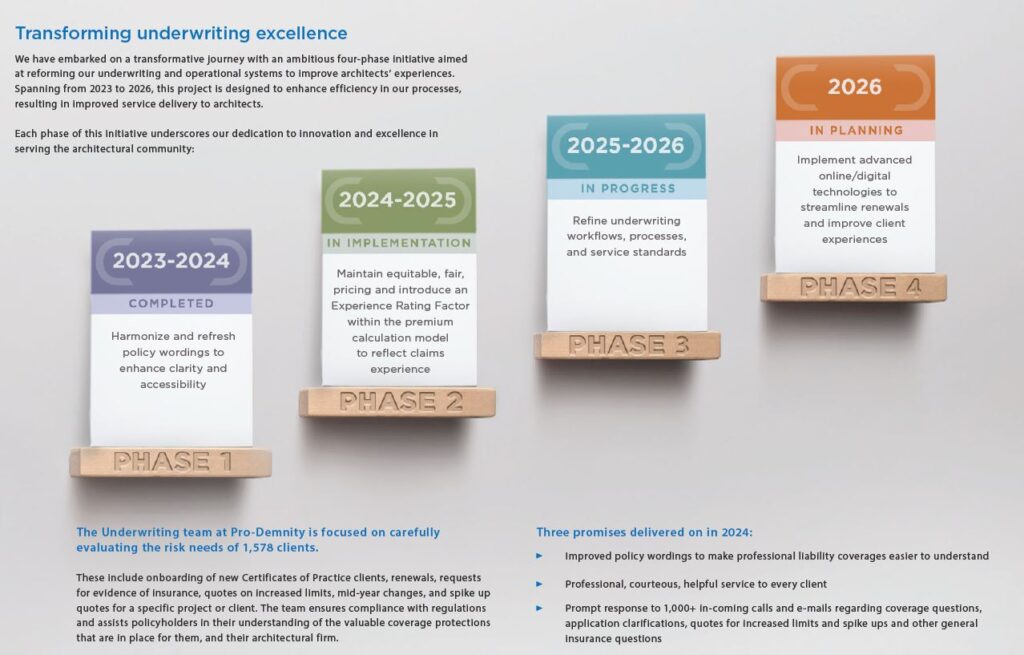
At Pro-Demnity, we are committed to providing reliable protection and service as your trusted ally. To better serve you and your firm, we are upgrading our underwriting systems throughout late fall 2025 and early winter 2026.
This enhanced system is part of our Underwriting Transformation initiative (Phase 3) and will enable us to respond to your needs and requests more efficiently.
During this transition period, you may notice duplicate automated messages as our new system comes online, and we phase out the older one. Please don’t be alarmed—this is a temporary occurrence and part of the process as we work to improve the overall experience.
1.Be aware that you might receive:
duplicate automated communications during the upgrade from late November 2025 through to March 2026. These may include reminders to submit your application, even after it has already been submitted, as there may be a slight delay in recording the received application. Please ignore duplicates or verify before acting.
2.If unsure, please contact Underwriting:
our team is available to assist with any questions or concerns you may have: mail@prodemnity.com or 416-386-1770.
We sincerely apologize for any inconvenience this may cause and greatly appreciate your patience and understanding as we make these important improvements.
Thank you for trusting Pro-Demnity. We look forward to continuing to serve you as your partner in protection.
Warm regards,
The Pro-Demnity Team
Important Notice to Policyholders: Supporting you during the Canada Post Strike
Dear Policyholders,
Due to the Canada Post strike, we want to ensure that you are aware of the necessary steps to continue managing your professional liability insurance policy payments and documentation without interruption. As a reminder, maintaining your professional liability insurance coverage at all times is a requirement for Certificate of practice holders as per the Architects Act. This means prioritizing premium payments to ensure continual coverage and avoiding policy lapse and cancellation.
If you are using courier services, kindly contact the receiving party at Pro-Demnity in advance to ensure that a member of the team will be available to sign for the package, as we are a hybrid-working company.
Payments:
Electronic Payments: You are strongly encouraged to make your payments electronically using the Pre-Authorized Debit (PAD) form. This method is secure, efficient, and unaffected by postal delays. For the duration of the postal strike, we can also provide you with instructions for making one lump sum payments directly from your bank account using online banking: EFT transfer, Bill Payment or Wire Transfer. Electronic payments are crucial during this time to ensure your payments are received and processed without delay.
Cheques in the Mail: If you have already mailed a premium payment or deductible payment cheque to our lockbox this week, please contact our Finance Department immediately at finance@prodemnity.com or 416-386-1770 X4 to discuss alternative arrangements for your upcoming payment, if necessary.
Processing time: Our team is working actively to support impacted clients. Please be aware that due to the strike, you may experience longer than expected wait times for this service, and that we will process requests in priority sequence.
Renewal, Spike-up or Increased Limits Applications:
Continue to submit applications for renewal, spike-ups or increased limits electronically to mail@prodemnity.com.
For underwriting documents such as applications for renewal, spike-up, or increased limits, please be assured that there are no impacts to processing times. Our team is fully equipped to handle these documents promptly and efficiently.
Claims Documentation: If you have sent any claims or litigation documentation via mail, please contact our Claims Department via e-mail at Claims@prodemnity.com or your Claims Specialist to confirm receipt and discuss any necessary next steps.
We appreciate your understanding and cooperation during this time. Should you have any questions or require further assistance, please do not hesitate to contact us.
Thank you for your continued trust and support.
Starting your own Architectural Firm in Ontario: Why Professional Liability Insurance is Essential
Launching your own architectural firm is a thrilling venture, but it comes with serious responsibilities. Professional Liability Insurance is one of them.
If you’re a licensed architect in Ontario contemplating the exciting leap into starting your own architectural practice, congratulations! This is a bold and rewarding step. But before you dive into branding, client acquisition, or project planning, there’s one foundational element you must prioritize: Professional Liability Insurance.
What Is Professional Liability Insurance (PLI) —and Why Is It Essential?
Professional Liability Insurance (also known as Errors & Omissions or Indemnity Insurance) protects your firm against claims of negligence, errors, or omissions in the usual and customary services you provide as an architect. In Ontario, professional liability insurance is a legal requirement under the Architects Act for any firm holding a Certificate of Practice.
This insurance ensures that if a client alleges your work caused financial harm—even if the claim is unfounded—your firm has the resources to defend itself. Without it, legal costs alone could threaten the viability of your business. Pro-Demnity, the insurer mandated by the Ontario Association of Architects (OAA), has almost 40 years of experience defending architectural firms and we proudly assert that no firm has ever gone out of business due to a covered claim[1].
Budgeting for Premiums: A Permanent Business Commitment
Starting a firm involves many costs, but your PLI insurance premium should be viewed as a non-negotiable investment.
The application for insurance is a one-time cost of about $300 CAD (including PST), and typically for a new firm starting out, premiums can be as low as $800 CAD, and can be significantly higher when the new Certificate of Practice comes into being due to a merger or acquisition (reflecting the liabilities of one or both of the previous firms). For firms anticipating gross fees under $50K in their first year, this coverage offers valuable protection with coverage starting at $250,000 per claim, making it affordable for new practices while ensuring strong coverage[1].
Every year, you’ll complete a renewal application for your firm in order to re-new your practice’s PLI. You’ll outline your firm’s gross fees for the usual and customary services provided by your architectural practice. This will help us assess risks and potential liability from the previous year and set the premium for the coming year.
Premiums for architectural firms are calculated by multiplying the 3-year average gross fees by the Rating Factor (determined annually by the company), which usually does not exceed 5%. While the Rating Factor may vary from 1% to 5% yearly, the calculation method remains consistent across all firms. Firms should make a habit of planning for a 5% annual rate increase in their budgets. Factoring this into your forecasts helps estimate future premiums, and guarantees that professional liability insurance is accounted for.
Being able to commit to paying your premium annually is a sign of your firm’s financial health and professional responsibility. It’s not just about compliance—it’s about safeguarding your reputation, your clients, and your future.
Growth, Mandatory Coverage Layers and Premiums
Your firm’s 3 year average of gross fees typically dictate the required mandatory coverage limits. As your firm grows out of one layer of coverage and into the next mandatory layer of coverage, you can expect a premium increase to be automatically triggered. Mandatory coverage layers are prescribed by the Architect’s Act (and not Pro-Demnity) and have been established as sufficient to protect the public first and foremost.
Here’s a rough guideline of when you can expect to qualify for the next layer of mandatory coverage:
Additional perks of PLI with Pro-Demnity
Included with your premium is access to valuable risk education resources and services, such as timely risk-related articles on our website, webinars, presentations, and opportunities to speak directly with one of our in-house architects whenever you have risk management questions.
Pro-Demnity’s professional liability insurance is also very unique to architects, and provides long-term protections, even after you’ve surrendered your Certificate of Practice and are no longer actively paying for your premiums. Our Retirement from Practice program extends for as long as the former Principal / Owner lives after surrendering their Certificate of Practice to the OAA, and then six years beyond death providing protection to the Estate and beneficiaries. This key benefit is only available with Pro-Demnity.
Other Insurance
Your firm will also benefit from insurance beyond professional liability. Consider Commercial General Liability, Business Interruption Insurance, Cyber insurance, and Director and Officers (D&O) Liability Insurance to name a few. Be sure to budget accordingly for these as well. Speak with your broker for what’s best for your firm’s needs as your start out. For professional liability insurance, purchase directly from Pro-Demnity.
Considerations when going from a Designer to an Architect
Newly licensed architects who previously operated as designers may face coverage challenges for ongoing projects.
Pro-Demnity coverage begins only after the Certificate of Practice is issued.
Prior work under “designer” status must be covered by separate insurance (see above)
Projects spanning both roles require careful coordination of coverage.
Architects transitioning from designer roles must ensure continuity of coverage and clarify which insurer is responsible for each phase.
A Quick Guide to Applying for PLI as a New Certificate of Practice Holder:
Let Pro-Demnity know that you are planning to start up a New Practice at Mail@prodemnity.com. Our underwriting team will e-mail you a New Practice Package with instructions to complete the form.
On the same day that you submit your Certificate of Practice application to the OAA, submit Pro-Demnity’s New Practice insurance application, fee and CASL form to Pro-Demnity.
Pro-Demnity will hold your application until the OAA Registrar approves your Certificate. It will then be processed, and coverage begins on the date your Certificate of Practice is approved. At that point, you’ll receive an invoice from Pro-Demnity outlining your premium and payment options for your prompt attention.
Get Educated: OAA’s “Fundamentals of Running an Architectural Practice” Course
This 13-module course, administered by the University of Toronto’s School of Continuing Studies, covers everything from regulatory frameworks and business structures to marketing, contracts, and—yes—professional liability insurance delivered by one of Pro-Demnity’s own employees (a retired OAA with 20+ years of experience with Pro-Demnity and 30+ years as a former Certificate of Practice holder). It’s designed to equip you with the tools and strategies needed to build a sustainable and successful practice.
Final Thoughts on PLI
Launching your own architectural firm is a thrilling venture, but it comes with serious responsibilities. Professional Liability Insurance from Pro-Demnity is your safety net, your legal shield, and your ally in risk management. Prioritize it from day one and pair it with solid business education like the OAA’s course, as well as ongoing risk education from Pro-Demnity, to set your firm up for long-term success.
At the core of your premium investment lies our dedication to offering you and your firm comprehensive legal defense and dependable claims support, ensuring you are equipped to address any allegations of errors, omissions, or negligence. We are committed to safeguarding your interests and championing your wise, effective and efficient management of architectural practice risk by serving as a steadfast ally in your protection.
Thinking of Designing your own Home? Five Things Every Architect Should Consider
By Leslie Parker, Sr. Architect Risk Alliance and Andrea Lalonde, VP, Underwriting
It’s not unusual for architects to turn their talents inward — sketching a dream kitchen, planning a long-awaited addition, or designing the perfect home for their family. But when you’re both architect and homeowner, how does your Professional Liability Insurance (PLI) respond, and what other risks should you consider?
Our Risk Alliance and Underwriting teams recently fielded this exact question and thought the insights would be helpful to share.
1. PLI Coverage Is Designed for Work Performed “for Others”
Your Professional Liability Insurance exists to protect you when you’re providing architectural services to clients — third parties who rely on your professional expertise.
But what if the client is you?
In this case, the situation is more nuanced. Since you’re both the homeowner and the architect, you effectively become both the service provider and the recipient. Most PLI policies, including Pro-Demnity’s, do not extend coverage to claims in which you — as the homeowner — would benefit from making a claim against your own practice.
2. Understanding the Limits of Coverage
Let’s say your home suffers serious water damage due to a defect in the exterior wall assembly. Your homeowner’s insurance covers the repairs — but the insurer then seeks recovery from your architectural practice, who prepared the permit drawings for the wall assembly.
That kind of claim — where the Certificate of Practice policy holder and the homeowner are the same person — would not be covered under your PLI.
However, if a third party — say, a guest visiting your home — is injured due to a design issue and sues your architectural practice, your policy could respond, depending on the circumstances and policy wording.
Another scenario: you sell the home. If a future owner makes a claim against your design work, your PLI could then offer coverage, again depending on the specific circumstances and policy wording.
3. Construction Phase Services May Be Excluded
Many architects who take on personal projects also manage the construction. If that’s part of your plan, be aware that Pro-Demnity’s PLI policy excludes coverage for services delivered during construction if you’re also acting as the constructor or construction manager.
In short: if you’re coordinating trades as the homeowner, while also providing construction phase services such as site review and shop drawing review as the architect, the overlap in roles may trigger a policy exclusion for those services. It’s a good idea to review Exclusion 29 of your policy for a fuller explanation.
4. Disclosure Is Required
You also need to disclose your role on your own home project to our underwriting team. You’ll be asked to complete a short form, which helps determine the insurable value of your services. That value factors into your policy’s premium calculation.
You can disclose this at any time during the project or at your next renewal, though you are encouraged to disclose these services sooner than later. The process is straightforward and promotes transparency in your coverage.
5. Spousal Consent and Ownership: Don’t Overlook the Human Factor
Designing your own home is often a personal dream — and sometimes, a shared one. If you’re in a spousal or common-law relationship, and the home is intended for both of you, it’s important to consider the risks that can arise when professional roles and personal relationships overlap.
Disagreements over design, unclear expectations, or future changes in the relationship can complicate the project and create potential liability — especially where cost decisions or design decisions were not well documented.
Seven Risk Management Best Practices
Separate your roles. Use different email addresses, filing systems, and communication channels for your work as architect versus homeowner. Treat the project documentation the same way you would for a client.
Hire engineers directly as the owner rather than through your practice. This reduces the chance that your architectural practice could be sued due to a consultant’s error, and any resulting coverage gap. Again, be clear which “hat” you are wearing in your communication with consultants.
Confirm that the engineers you hire as homeowner carry their own PLI — and the amount.
Review your full insurance picture. Beyond your PLI, speak with your broker about what other insurance coverage may be appropriate during construction — and confirm your contractor’s coverage.
Consider disclosing your dual role on the project to your property insurer, and discuss any concerns.
Get your spouse’s approval. Documented agreement on design and cost decisions can help avoid future disputes — especially if expectations change.
Consider legal advice on ownership implications. Understand how the ownership structure of the home may affect your liability exposure — especially if your architectural practice is performing the work and you share ownership with a spouse or partner.
By understanding how your PLI policy responds, making thoughtful disclosures, and addressing both the professional and personal dimensions of your project, you can reduce the likelihood of unpleasant surprises down the road — and enjoy your new home with greater peace of mind.
For more personalized architectural practice risk management advice, you may request a complimentary and confidential meeting to Speak with an Expert or Report a Claim.
Our Contributors
Leslie Parker, M.Arch, OAA, MRAIC, is an experienced architect with extensive knowledge in contract administration and project management of large teams, as well as deep expertise of built environments for healthcare, long-term care homes, and design for seniors. As Senior Architect, Risk Services at Pro-Demnity, she monitors new developments in the profession and leverages this knowledge to contribute to the research and development of Pro-Demnity’s risk education material, initiatives and programs, while offering relevant and timely one-on-one risk guidance to architects. She is a licensed Ontario architect, with a BA from St. Thomas University, Fredericton, New Brunswick, as well as a Bachelor of Environmental Design Studies and Master of Architecture from Dalhousie University, Halifax, Nova Scotia.
Andrea Lalonde, CIP, is a professional liability insurance expert with 22 years of experience at Pro-Demnity. She is a seasoned insurance leader, and as Vice President of Underwriting, oversees the Underwriting Team, ensuring excellence in risk assessment and coverage provisions. With an acumen for re-insurance, Andrea’s expertise is in providing Ontario architects with specialized professional liability coverage for their practices. She is a Chartered Insurance Professional (CIP) committed to professional excellence in the insurance industry and holds membership with the Professional Liability Underwriting Society. Andrea’s greatest professional joy is when architectural practices succeed in understanding their insurable coverage and leveraging insurance protections appropriate to them.
The Best Contract for an Architect to Use
Pro-Demnity has provided many articles and Bulletins encouraging the use of the readily available standard forms of contract for the provision of architectural services provided by the OAA. Failure to adhere to this advice is a common factor contributing to Professional Liability Insurance Claims incurred by Ontario architectural practices.
This Article supplements two relevant articles available on the Pro-Demnity website:
Pro-Demnity’s risk management advice consistently emphasizes the importance of a written contract with every client and subconsultant on every project. This advice draws on over 35 years of experience managing and settling claims on behalf of the Ontario Architects we insure.
One of the common questions we hear in response is “What contract should I use?” or sometimes, “Does Pro-Demnity have a sample wording I can use?” This article addresses those questions.
It concludes with a recommendation that Architects take full advantage of OAA Document 800-2021A – Standard Short Form of Contract for Architect’s Services, as their own “Standard Terms and Conditions” respecting the provision of their architectural services. This should be partnered with OAA Document 900-2021A – OAA Standard Form of Subcontract Between Architect and Subconsultant when retaining services of any engineering or other specialty subconsultants.
What is a Contract?
A good starting point is to remind ourselves of four elements of an enforceable contract:
An Accepted Offer … between the parties. There are many ways an offer and acceptance related to the provision of architectural services can be accomplished. A simple example is where an architect offers to provide its services for a project to a client and the client accepts the architect’s proposal.
Consideration … what each party promises to do or deliver to the other. In our most common example, the Architect promises to deliver a specific scope of architectural services to a client for a project. In return the client promises to compensate the Architect by paying an agreed fee and reimbursing expenses incurred by the Architect.
Competence of the Parties … the Agreement must be between individuals who are of sound mind (are sane), and old enough to be legally considered an adult (18 in Ontario). When representing a business entity, the individual must have the authority to bind or make enforceable commitments on behalf of the business.
Legality of Purpose … a contract to undertake an illegal activity is not enforceable by a court. An example we hope you are NOT familiar with is where an architect with an OAA seal agrees to assist a non-architect – perhaps an engineer or non-professional designer such as a BCIN – practice “architecture” in Ontario. If an Architect agreed to apply its OAA seal on work carried out by a non-architect, the Architect would be in breach of the Architect’s Act and Regulation and the agreement to do so would be for an illegal purpose. If the Architect wasn’t paid by the non-architect, the Architect would not be able to rely on the contract with the non-architect (oral or written) to collect what the non-architect had agreed to pay for the improper use of the Architect’s seal.
Oral or Written Contract?
A Contract may be oral or written. An oral contract is based on the spoken word, a written contract is in writing. Both may be binding and enforceable; although with an oral contract, if a dispute arises, it will be rare to have both parties remember the terms the same way. The well-known adage, An oral contract isn’t worth the paper it’s written on (or not written on) applies time after time in claims or litigation involving Architects. A court will accept that there was a contract between the parties; however, one or both parties may be surprised at the conclusion the court reaches regarding what was agreed to, when their memories differ.
Nearly as undesirable is where a one-line email might be the only written portion of a contract, leaving the court to read-in any number of “implied terms” to that contract.
Pro-Demnity consistently advises Architects that they should insist upon a written contract in their dealings with a client – the project owner – and with any subconsultants they retain.
However, we are regularly surprised to find an Architect has signed a written contract with its own client – the project owner – while relying on a “handshake” – an oral agreement – with their subconsultants.
And too often the Architect has accepted a subconsultant’s written terms and conditions in a subcontract with the subconsultant that are incompatible with the terms and conditions the Architect has agreed to in its own “Prime” contract with the project owner. The outcome can be a serious “gap” between the scope of services the subconsultant has agreed to provide for its fee, and what the Architect has agreed to provide / deliver in its own contract with the owner. These “gaps” can contribute to claims by the Architect’s client – the project owner – related to inadequate services provided by the Architect’s subconsultant.
Ontario Architects are fortunate to have several variants of “standard” forms of contracts with clients or subconsultants available “off the shelf” including:
OAA Document 600-2021A – Standard Form of Contract for Architect’s Services
OAA Document 800-2021A – Standard Short Form of Contract for Architect’s Services
OAA Document 900-2021A – OAA Standard Form of Subcontract Between Architect and Subconsultant
Note: Each of the OAA forms of contract noted above comes in two variants. An “A” following “2021” designates a version for use by an Architect, “LT” signifies the variant for use by a “Licenced Technologist OAA”. The RAIC and CCDC forms of contract do not include this Ontario-specific distinction.
The Royal Architectural Institute of Canada (RAIC) provides its own forms of standard contract suitable for use in any Canadian province or territory, including Ontario. Provisions are similar but not identical to those found in OAA 600-2021A and OAA 900-2021A. The RAIC has discontinued a short form of contract.
RAIC Document Six – 2022 – Canadian Standard Form of Contract for Architectural Services
RAIC Document Nine – 2022 – Canadian Standard Form of Contract between Architect and Consultant
The Canadian Construction Documents Committee (CCDC) is the recognized provider of construction delivery contracts in Canada. However, CCDC has added several contracts for the delivery of consultant services to its repertoire including:
CCDC 15 – 2013Design Services Contract between Design-Builder and Consultant – for design-build projects where the Architect’s client is a Contractor acting as a Design-Builder.
CCDC 31 – 2020Service Contract Between Owner and Consultant (consulting engineer). Originally adapted from ACEC 31-2010 – Engineering Agreement Between Client and Engineer, we expect it could also be used for architectural services.
CCDC 30 – 2018Integrated Project Delivery Contract – 3-way contract between Owner, Consultant(s) and Contractor(s)
The following primarily focuses on the OAA standard forms of Contract OAA 600-2021A (Architect and Client – Long Form), OAA 800-2021A (Architect and Client – Short Form) and OAA 900-2021 – Architect and Subconsultant.
Client-Authored Contracts and /or Changes to Standard Forms of Contract
One of the most common reasons for architects to reach out to Pro-Demnity’s Risk Services is to understand the implications of client-authored versions of a contract for architectural services or client-authored amendments (Supplementary Conditions) to the standard forms of contract provided by the OAA or the RAIC.
Many architects may be surprised to learn that – with a few important exceptions – Pro-Demnity itself isn’t particularly concerned with what an Architect agrees to in a contract it signs with a client. Nothing an Architect agrees to in a contract with a client will change the scope and limits of the Architect’s coverage under its Pro-Demnity policy. The Architect’s coverage will not increase or decrease by accepting client-authored amendments. However, the constant risk is that an Architect will agree to financial obligations to the client that will NOT be covered by the architect’s professional liability insurance.
These risks include the architect agreeing to the following:
Agreeing to Indemnification wordings that exceed the Architect’s existing indemnification obligations “at law”. An Architect’s obligations to indemnify its client are already established under common law. These obligations are what will be covered by a professional liability insurance policy. Any additional obligations that the Architect agrees to in a contract with a client will NOT be covered by the Architect’s professional liability insurance.
Agreeing to Dispute Resolution wordings that will prejudice or eliminate Pro-Demnity’s ability to manage or deliver the defence to a claim covered by the architect’s insurance. Agreeing to dispute resolution provisions that include mandatory use of arbitration or allow the client to dictate the settlement process are now subject to a sublimit on BOTH defence costs and any damages assessed against the architect of a total of $50,000 per claim, $100,000 annual aggregate. Once those sublimits are exhausted, the architect will be on its own.
Agreeing to provide services that fall outside what would be considered “usual or customary”. These could include delivery of construction, delivery or retention of surveyors, geotechnical investigations, and services related to identification and / or mitigation of pollutants or toxic or hazardous substances. Some clients attempt to include these uninsured activities in an Architect’s scope of work, and some Architects fall into the trap of agreeing to provide them rather than saying “no!”.
The standard forms of contracts with clients for architectural services provided by the OAA and the RAIC avoid these pitfalls.
OAA Document 600-2021A
Article A12 has the Client and NOT the Architect providing:
surveys,
subsurface investigations,
a list and evaluations of Toxic or Hazardous Substances – as defined in the Definitions section of the contract,
air and pollution tests, tests for Toxic or Hazardous Substances etc. as reasonably required by the Architect, the Architects Consultants and authorities having jurisdiction, and
a written legal description of the site
The Indemnification wording GC09 Indemnification and Liability of the Architect – Item 9.1 essentially adopts wording that Pro-Demnity has been providing as “benign” – reflecting an architect’s existing liability “at law” – and therefore does not expose the Architect to uninsured liability.
The Dispute Resolution provisions in GC 16 have been carefully worded to avoid triggering the Sublimit on defence costs and damages in the Pro-Demnity Policy. For instance, GC 16.5 includes the option of utilizing arbitration being Subject to mutual agreement, NOT at the Client’s sole discretion, and GC 16.6 provides conditions that the Client must include in a construction contract related to the Architect’s participation in an arbitration process between the Owner and Contractor.
Schedule 2 – Basic Services and Schedule 3 – Additional Services do NOT include services that would fall outside what is “usual or customary” for an Architect to provide, subject to the definitions included in the contract.
However, as noted above, attempts by a client (or the Architect) to amend the dispute resolution wording provided, or change any of the relevant definitions can trigger serious coverage problems.
RAIC Document Six – 2022
RAIC Document Six – 2022 – GC3 Client’s Responsibilities identifies the provision of the following as the client’s responsibility:
3.2.1 – Legal description and surveys …etc., pertaining to the Place of the Work,
3.2.2 – Subsurface investigation reports…etc., including a list of and evaluations of Toxic or Hazardous Substances or Materials present at the Place of the Work…etc., with appropriate professional recommendations.
3.3.3 – Air and water pollution tests, tests for Toxic or Hazardous Materials, structural, mechanical, chemical or other laboratory and environmental tests, inspections, field tests and reports with appropriate professional recommendations, and
3.3.4 – All available information on existing buildings, including investigation or condition reports, facility management drawings, and original drawings and specifications…etc.
RAIC Document Six – 2022 – GC8 Indemnification – Item 8.1 combined with GC9 – Limitations on Liability – Item 9.1 limit the Architect’s liability to the Client to either:
the amount of insurance coverage … that is available at the time the claim is made, or
the amount stated (i.e., agreed to) in Article A21.
RAIC Document Six – 2022 also includes dispute resolution provisions in its GC14 that – unless changed – will not trigger the new sublimit on defence costs and damages payable by Pro-Demnity.
OAA Document 800-2021A
OAA Document 800-2021A (6 pages) is somewhat longer than its predecessor OAA 800-2011 (2 pages); however, it remains much shorter than OAA Document 600-2021A (28 pages) or RAIC Document Six – 2022 (14 pages) and therefore may be less intimidating to many architects and their clients.
The philosophy behind Document 800 is to NOT include provisions that are already addressed by established law, and include only a limited number of provisions that address the most common areas giving rise to disputes where there is no written contract – primarily scope of services to be provided by the Architect and fees to be paid to the Architect by the client.
Importantly, GC05 – Indemnification and Liability of the Architect repeats the same “benign” indemnification wording adopted in OAA 600-2021A.
It avoids many of the other common arguments with a brief description of the Client’s responsibilities in the Agreement – Item A09:
The Client shall provide information regarding existing conditions including the legal description of the property, surveys, soils, and sub-surface conditions, toxic or hazardous substances, reports, services, existing structures, etc., related to the Place of the Work, reasonably required for the performance of the Services, the accuracy and completeness of which the Architect shall be entitled to rely upon.
It does not include a Dispute Resolution provision, relying instead on “silence in the contract”. The reality is that if there is a dispute between the Architect and the client regarding the interpretation of contract provisions related to the obligations of either party, they already have access to any of negotiation, mediation, adjudication, and – if both agree – to binding arbitration as resolution tools. However, if settlement is not reached, the courts remain available as a publicly funded route to final resolution.
An important benefit is that the “Silence in the Contract” approach will not trigger the sublimit on defence costs and damages payable on behalf of the Architect.
Conclusion – What Contract Should You Use?
Architect – Client Contracts:
The answer is “It depends!” However, we consistently recommend the use of the OAA’s standard contracts.
In many instances, the Architect isn’t given a choice, and their only option is to accept a client contract or to decline pursuing the commission. For many categories of projects and clients, the decision is in the hands of the client, who includes its form of contract as a prerequisite in its RFP. These can be a set of Supplementary Conditions to one of the available “Long Form” agreements – OAA Document 600 – 2021A (or earlier editions – OAA Document 600-2013 is still used by many clients), or RAIC Document Six – 2022 (or earlier editions).
It may appear that the client is using one of the OAA contracts, however, most often the Supplementary Conditions are so extensive that the original intentions of the underlying standard form are unrecognizable, and the willingness of the client to consider or negotiate changes proposed by an Architect is non-existent. It is only when the client fails to receive enough responses to meet its own procurement criteria that reluctant consideration is given to amendments to the client’s contract.
In effect, the contract terms are considered by the client to be “take-it-or-leave-it”, and it is only when Architects choose to “leave-it” that changes might be negotiated. For some guidance on improving your negotiating position, please visit our 2025 OAA Conference Presentation Resources, which includes our presentation: David V Goliath: A stone’s throw away to a better negotiating position or read the summary of this presentation.
Long Form or Short Form?
There is a general assumption that longer forms of standard contracts such as OAA 600 or RAIC Document Six are more appropriate for larger, more complex projects, and shorter forms of standard contracts should be reserved for smaller projects. However, where one draws a clear line, is another “it depends” consideration. There is not a “one size fits all” answer.
For most applications, OAA Document 800-2021A – including a Schedule (or Schedules) setting out the agreed scope of services and fees for those services – will provide the essential elements of an enforceable written contract. The OAA provides sample Schedule forms; however, the objective might also be met by attaching e-mails, memoranda, or other correspondence between the client and architect as the Schedule(s).
And as noted earlier, when an Architect is able to propose the form of contract, OAA Document 800 -2021A has the significant advantage of appearing far less formidable to both clients and architects. In addition, to date, it has not generated the same extraordinary enthusiasm by clients (and their lawyers) to dramatically amend it as has been the case for the longer forms of standard contracts.
Unfortunately, despite the OAA’s efforts to ensure a fair balance between the interests of clients and architects, many publicly funded client organizations, including Infrastructure Ontario, Boards of Education, Colleges and Universities, Municipalities and their many agencies have invested in extensive efforts to modify the long-form contracts – attempting to transfer their own risks as owners and clients onto the architects / consultants. The same applies to some larger private clients as well. This pre-emptive strike by the clients has made it very difficult, if not impossible, for an architect to negotiate changes. These factors may discourage consideration of the use of a short form of contract, without the client attempting to add a long list of changes it has already invested in to modify the long forms.
Architect – Subconsultant Contracts:
Another type of contract that Architects will be party to has an engineering subconsultant agreeing to provide its specialized engineering services to the Architect on a project. In exchange, the Architect (the subconsultant’s client) promises to pay an agreed portion of its own fees on the project to the subconsultant.
Many engineering consultants provide their own “Standard Terms and Conditions” with every fee proposal they provide to a potential client – including to architects assuming the role of “Prime Consultant” in its own contract for architectural services with a project owner. Pro-Demnity’s consistent advice has been to NOT accept any subconsultant’s “standard terms and conditions”. More information can be found below:
Propose or require the use of OAA Document 800-2021A, as your “standard terms and conditions” for every proposal for professional services you offer to a potential client. If your “offer” including the use of OAA Document 800 is accepted, you will have an enforceable contract in place – subject to the accepting client or its representative having the competence and authority to enter into a contract on behalf of the client organization.
Encourage a potential client to retain any other specialists required for the project directly. This approach has the benefit of avoiding your assuming vicarious or contractual liability for the services (and failings) of these specialists, or financial liability to the engineering or other specialists if your client fails to pay you for your and your subconsultants’ services. It may result in lower professional liability insurance premiums as well, since Pro-Demnity will not have to cover the contractual liability for these consultants you might be exposed to if you retain them yourself.
If you are agreeable to retaining any of the required engineering or other specialists, DO NOT accept any potential subconsultant’s “Standard Terms and Conditions”. Instead, insist upon use of YOUR standard terms and conditions – being OAA Document 900-2021A – binding the subconsultant to the same terms and conditions you have agreed to in whatever form of “prime” contract you have with the project owner / your own client.
Pro-Demnity cannot dictate what contract terms you are willing to accept. Notwithstanding our strong recommendation that a written contract is one of your best risk management tools, on very rare occasions NOT signing a contract with unreasonable provisions may be the least “bad” option – other than declining the commission. Before considering this option, be sure to obtain legal advice in the hope of avoiding being deemed to have agreed to the unreasonable provisions based on your actions.
If you have questions about the content of this article or would like further assistance in dealing with a contract question or other risk management challenge related to your practice, Pro-Demnity Risk Alliance advice can be accessed via Speak with an Expert.
Our Contributor
John Hackett, OAA (Retired), MRAIC describes himself as the “voice at the end of the phone”, responding to Architects’ enquiries for risk education and risk services support. He serves as Pro-Demnity’s Executive Advisor on the Senior Leadership Team and is an experienced risk management strategic resource.John’s expertise spans over 22 years with Pro-Demnity helping architects to understand the risks associated with practice. He also brings significant experience as a previous co-owner of an architectural practice. John has a deep awareness and “architect life experience” to the need and value of professional liability insurance. He has a keen sense and instinct to identify the “trouble” moments and communicate those issues of concern with architects and others. With extensive knowledge of publicly funded institutional clients and projects where stakeholder financial support and successful fundraising are critical, John is a staunch advocate for the profession of architecture and for architects’ professionalism.
David v Goliath: Enhancing Negotiation Strategies for Architects
Introduction
At the 2025 OAA Conference in Ottawa, John Hackett, Salvador Knafo, Philip Ghosh, and Leslie Parker presented a compelling session titled “David v Goliath: A Stone’s Throw Away to a Better Negotiating Position.” This article summarizes the key points from their presentation, offering valuable insights into improving negotiation strategies for architects.
The Challenge of Negotiation
Architects often feel inadequately equipped to negotiate contract terms, facing daunting legal implications and concerns about Professional Liability Insurance (PLI) requirements and coverage. The session aimed to empower architects with the tools and strategies needed to navigate these challenges effectively.
Architects’ Allies
Architects have several allies to support them in negotiations:
OAA Practice Advisors: Offering guidance on practice-related issues.
RAIC Practice Advisory Service: Providing resources like the Canadian Handbook of Practice (CHOP).
CEO Engineers: Assisting architects in saying “No” to unfavorable terms.
Pro-Demnity: Offering risk services, education, bulletins, and articles.
Client Project Team Members: Valuing the working relationship with architects.
Your Arsenal for Negotiation
Architects can leverage several tools to enhance their negotiating position:
Willingness to Look After Your Own Interests: Take the lead in negotiations, with support from Pro-Demnity and OAA.
Professional Status and Knowledge: Your scope of practice is protected, and you offer tangible value as a professional.
Standard Forms of Contracts: Utilize standard contracts like OAA Document 800-2021, OAA Document 600-2021, RAIC 6-2022, and others.
Engineering Subconsultants: Use ACEC Document 31-2010 for agreements between clients and engineers.
Legal Advisors: Seek legal assistance through Pro-Demnity’s risk services.
Client Representatives: Build relationships with clients who value your expertise.
The Power of Saying “No”
One of the strongest negotiating tools is the willingness to say “No” professionally and diplomatically. Architects can propose alternatives that align with their interests and limitations, such as:
Limiting indemnification obligations to the coverage and limits of their PLI.
Ensuring dispute resolution provisions do not restrict the PLI insurer’s ability to defend.
Maintaining existing PLI limits or seeking client reimbursement for higher limits.
Case Study: Email Exchange
An email exchange (which Pro-Demnity typically wouldn’t see) between a client project manager and their lawyer highlighted the importance of standing firm on contract terms. The architect’s refusal to accept unfavorable changes led to the lawyer advising the client to “tolerate” the architect’s proposed changes to avoid project delays.
Arbitration: A Four-Letter Word
Salvador Knafo discussed the drawbacks of mandatory arbitration, including:
Increased costs passed on to all Ontario architects.
Reasonable Liability Clauses
Philip Ghosh emphasized the importance of reasonable liability clauses in contracts. Architects should:
Limit responsibility for other consultants.
Make explicit that architects do not control construction.
Limit liability to insurance limits.
Eliminate exposure to consequential loss.
Combatting Shifting Narratives
Leslie Parker addressed the fight against shifting narratives for an architect’s standard of care in site review. Architects should:
Use irrefutable facts to combat misrepresentation.
Call out those who misrepresent facts.
Read contracts carefully to avoid signing away their defense.
Conclusion
Negotiating contract terms can be challenging, but with the right tools and strategies, architects can enhance their negotiating position and protect their interests. By leveraging allies, utilizing standard contracts, and standing firm on key issues, architects can navigate negotiations effectively and ensure a better outcome for their practice.
For more personalized architectural practice risk management advice, you may request a complimentary and confidential meeting to Speak with an Expert or Report a Claim.
How to Access Pro-Demnity Services During a Postal Service Disruption
In case there’s a postal service disruption affecting mail delivery, we want to make sure you know how to keep managing your professional liability insurance policy payments and documentation smoothly. Keeping your professional liability insurance up to date is essential for Certificate of Practice holders, as required by the Architects Act. This means it’s important to prioritize your premium payments to ensure you always have coverage.
Payments:
Electronic Payments: Make premium or deductible payments electronically using the Pre-Authorized Debit (PAD) form. This method is secure, efficient, and unaffected by postal delays. Instructions for making one lump sum payments directly from your bank account using online banking via EFT transfer, Bill Payment or Wire Transfer may be found on page 2 of the Payment Options form. Electronic payments ensure your payments are received and processed without delay.
Cheques: We strongly recommend that you transition from cheque payment to electronic payment to avoid any delays in the processing of your premiums. If you have already mailed a premium payment or deductible payment cheque to our lockbox, and aren’t sure if it’s been processed, please contact our Finance Department immediately at finance@prodemnity.com or 416-386-1770 x4 to discuss an alternative electronic payment arrangement for your upcoming payment, if necessary.
Renewal, Spike-up or Increased Limits Applications:
Continue to submit applications for renewal, spike-ups or increased limits electronically to mail@prodemnity.com.
Processing times for renewals, spike-ups or increased limits applications are not impacted by postal disruptions. Our team is fully equipped to handle these documents promptly and efficiently when submitted electronically.
Claims Documentation: If you have sent any claims or litigation documentation via mail, please contact our Claims Department or your Claims Specialist to confirm receipt and discuss any necessary next steps.
Should you have any questions or require further assistance, please do not hesitate to contact us.
Thank you for your continued trust and support.
Pro-Demnity’s 2025 OAA Conference Materials
Pro-Demnity is proud to support the architectural profession in its pursuit of Reshaping Communities at the 2025 OAA Conference in Ottawa, Ontario. We are pleased to be a lead sponsor again this year.
The resources provided below and at this conference offer valuable tools and insights to empower you and your firm, enabling you to navigate risks confidently, wisely, and efficiently.
Visit us at the Pro-Demnity booth in the Conference Lounge.
Resources/Presentations
CE6: David v Goliath: A stone’s throw away to a better negotiating position Moderated by: John Hackett, Executive Advisor Presenters: Salvador Knafo, Lead Architect; Phil Ghosh, Managing Counsel; Leslie Parker, Senior Architect. Qualifies for 1.5 Structured CE credit. Thursday, May 15 8:30 am – 10:30 am
Read the presentation Highlights.
Take the Architectural Risk Management Assessment Review (ARM/r) for a quick way to potentially identify gaps in your risk management systems. Check your ARM/r now!
Risks of Expedited Housing Design and Construction. This article from 2024 Conference was a hit with architects. We’re sharing it again as it offers relevant insights. Authors: Leslie Parker, Senior Architect and Iliana Arapis, VP Client Experience.
Additional Resources
To download any of the following resources, click on the ellipses embedded with the resource shown and select “Download PDF File”.